Strategy guide
How to Win a World Title in Boxing Career: 2,400 Careers
We let the computer play Boxing Career 2,400 times, changing one decision at a time. Two choices decide whether you ever hold a belt. Most of the others barely move the needle.
Every Boxing Career run is a long string of small decisions: which child to pick, which gym, which clinic, when to turn professional, whom to fight, how to prepare, whether to cut weight. Players ask us which of those decisions actually matter. Instead of guessing, we asked the game. We took the automated player we use to balance it, gave it a sensible strategy, and then changed one decision at a time, running 200 full careers for each version: 2,400 careers in all, from age eight to retirement. Here is what came out.
The short version
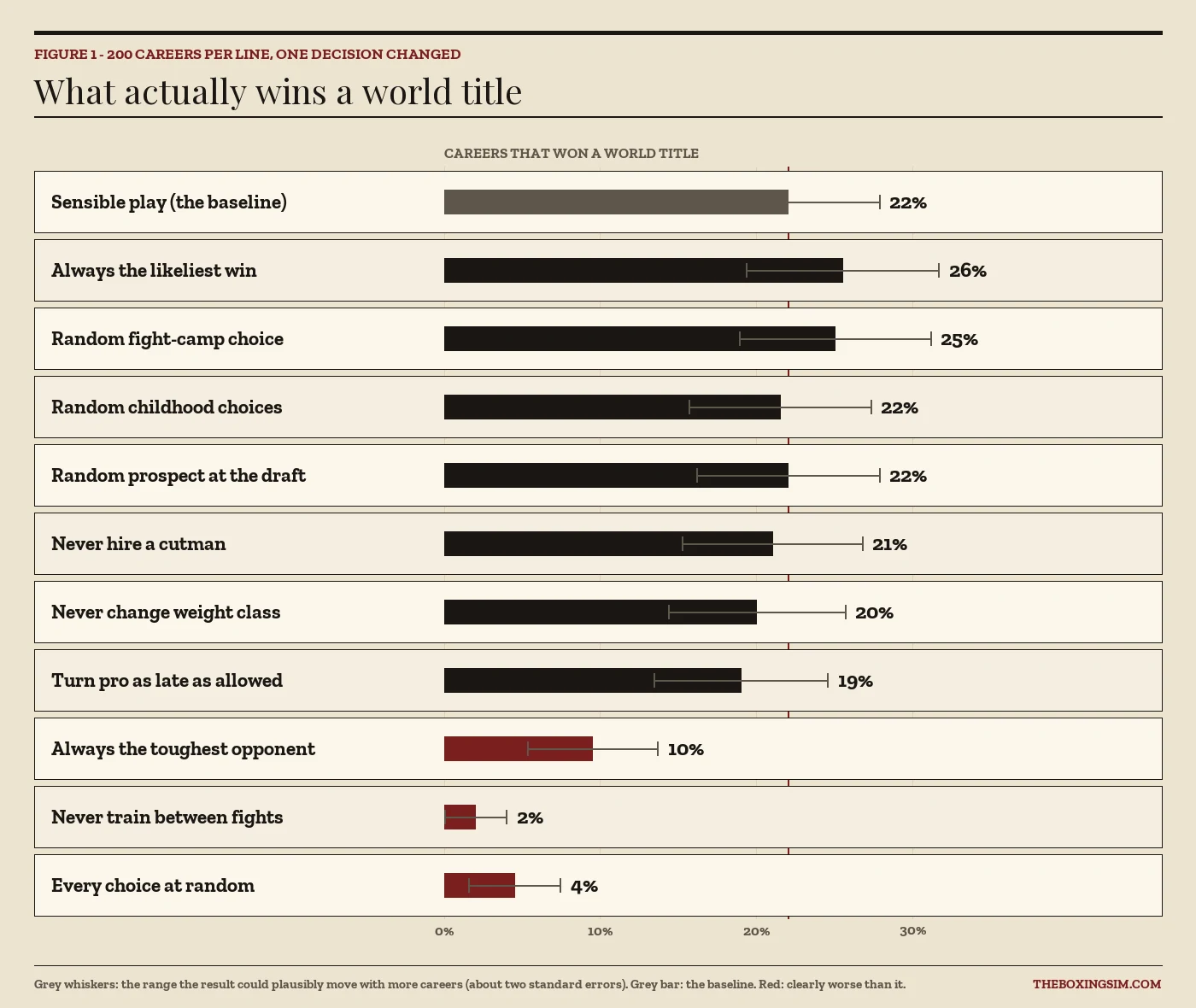
- Train between fights. It is the single biggest decision in the game. Skip it and your chance of a world title falls from about 22% to 2%.
- Climb with fights you can win. Always taking the toughest opponent cut the title rate to 10% and ended a quarter of careers with an F.
- Manage your weight. It barely changes the title odds, but it stops you missing weight and losing a fifth of your purse.
- Do not agonise over the rest. The draft pick, childhood choices, fight-camp option and cutman all made differences too small to measure.
How we tested it
Boxing Career has a test script that plays the real game code, the same file your browser loads. Its sensible player picks the prospect with the most potential, takes the childhood options with the biggest stat gains it can afford, turns pro as soon as it is allowed, trains when it has the money, takes the opponent it is most likely to beat (with a slight preference for real tests over tune-ups), moves up or down a division when the weight is wrong, hires a cutman when it can, and takes title fights when they come.
That player becomes world champion in 22% of careers. A player who makes every choice at random manages 4%, and one who makes every worst choice never does. Then we built ten versions of the sensible player, each with one habit changed, and let each one live 200 lives.
One honest caveat. With 200 careers per version, results can wander by a few points from luck alone, so the chart shows a range for each line. A difference of two or three points is noise. A difference of ten points is real.
1. Training is the game
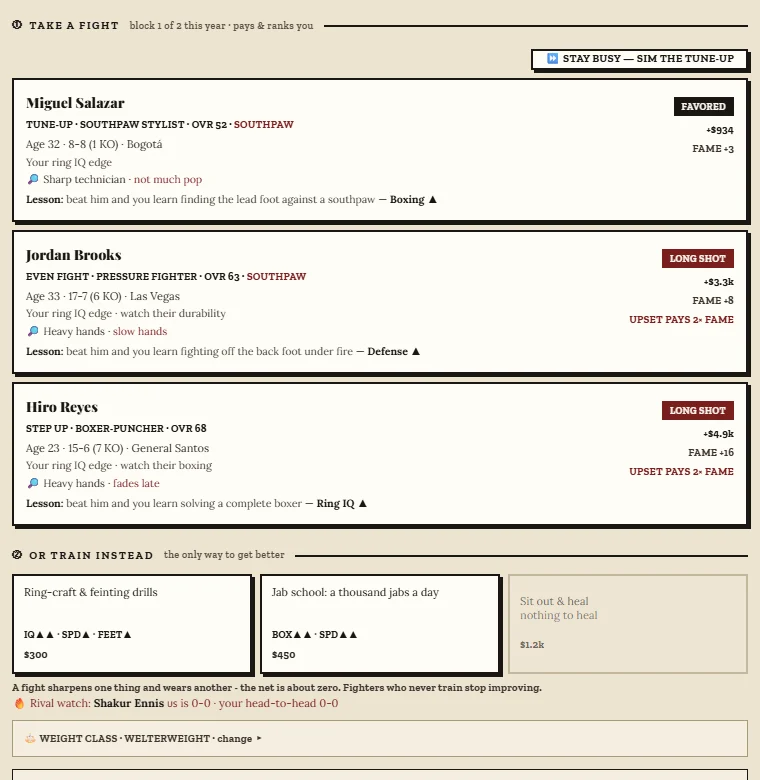
Every block of a professional career offers you a choice: take a fight, or train instead. The fight is tempting. It pays a purse, adds a win to your record and moves you up the rankings. But a fight sharpens one attribute and wears another, so on its own it does almost nothing to your rating. Training is what makes you better.
The boxer who never trains shows how much that matters:
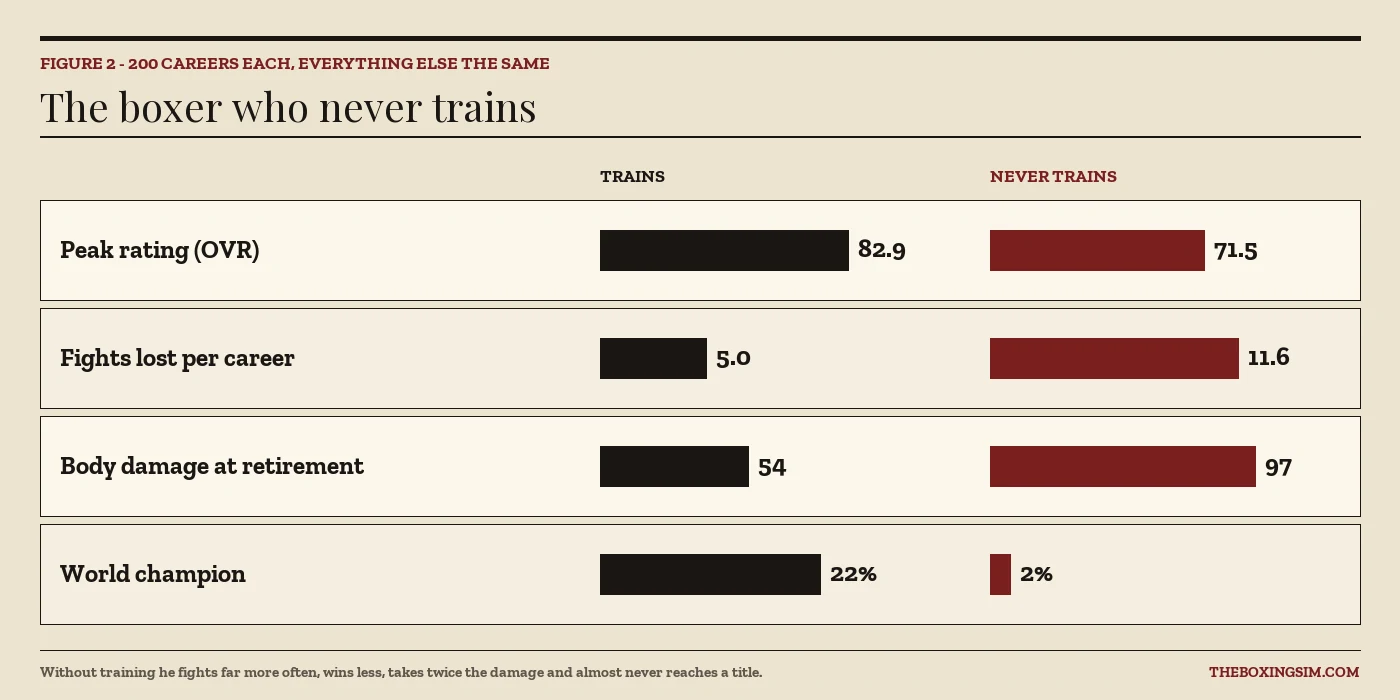
He peaks at an overall rating of about 71, against 83 for the boxer who trains. He fights far more often, because he has nothing else to do, so he loses more than twice as many fights and retires with nearly twice the body damage. And he wins a world title in about 2% of careers. No other decision in the game comes close to that.
What to do: train whenever you can afford it, especially early. Treat fights as the way you climb the rankings and earn the money for the next block of training, not as the way you improve.
2. Pick your fights
The second big lever is whom you fight. Each block offers a tune-up, an even fight and a step up, with the odds and the purse on each card. We tried two extremes. The boxer who always took the toughest opponent won a world title in only 10% of careers, half the baseline rate. Worse, more than a quarter of those careers ended with an F grade, and they ended young: on average at 34 instead of 38.
The reason is a rule that matters more than any stat: four straight defeats end a career. A boxer who keeps stepping up before he is ready loses in clusters, and a cluster of four is the end. Rushing does not get you to the title faster; it gets you out of the sport.
The opposite extreme, always taking the fight you are most likely to win, did at least as well as the baseline, at 26%. Wins move you up the rankings whoever they come against, and a long winning run is how you get the eliminator and then the title shot.
What to do: take the favoured fights while you are improving, step up when your rating has caught up with the next level, and never take a long shot when you have just lost two in a row.
3. Fight at the right weight
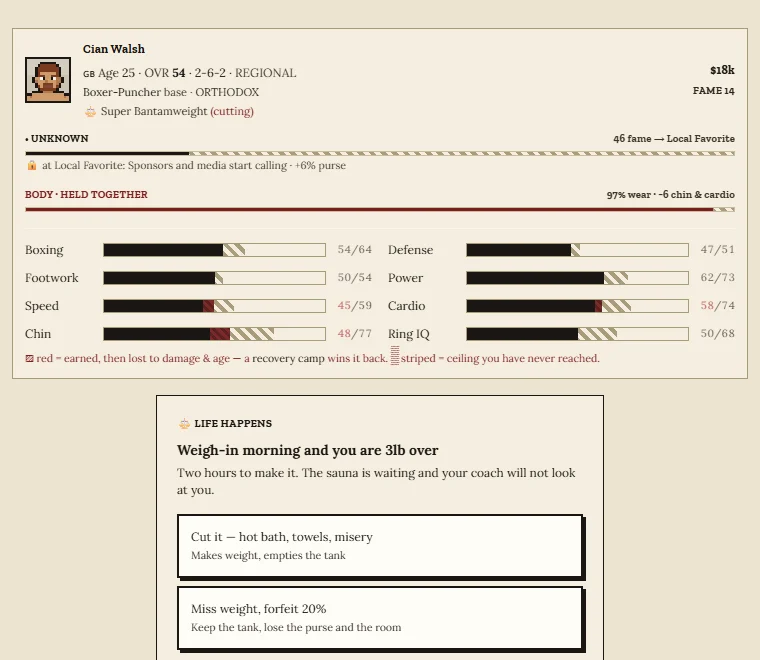
Your boxer grows, and the division he started in gets harder to make. The boxers who never changed weight class missed weight about 1.6 times per career, against about 0.2 for those who moved when the cut became hard. Each miss costs 20% of the purse, and making the weight the hard way leaves you fighting with an empty tank.
The effect on the title rate was small, 20% against 22%, inside the margin of luck. Weight is not what wins you a belt, but it is an easy way to lose money and fights for no reason.
What to do: when the game tells you the cut is getting serious, move up. If you are the small man in your division, consider moving down. Do not do either while you hold a belt or sit at the top of the rankings.
What matters less than you think
Some of the decisions players worry about most made no measurable difference to the title rate.
- The draft pick. Picking the prospect with the most potential raised the peak rating by about two points, and produced more S grades, but the title rate was the same. Potential sets a ceiling; training decides how close you get to it.
- Childhood choices. Taking random options in the amateur years left the boxer a few points weaker when he turned pro, but he caught up. They shape your story and your style more than your results.
- The fight-camp option. A random camp choice did as well as always taking the first one. That does not mean camps do not matter. Our bot cannot read the opponent, and a human who picks the camp that answers the specific problem in front of him should do better than either.
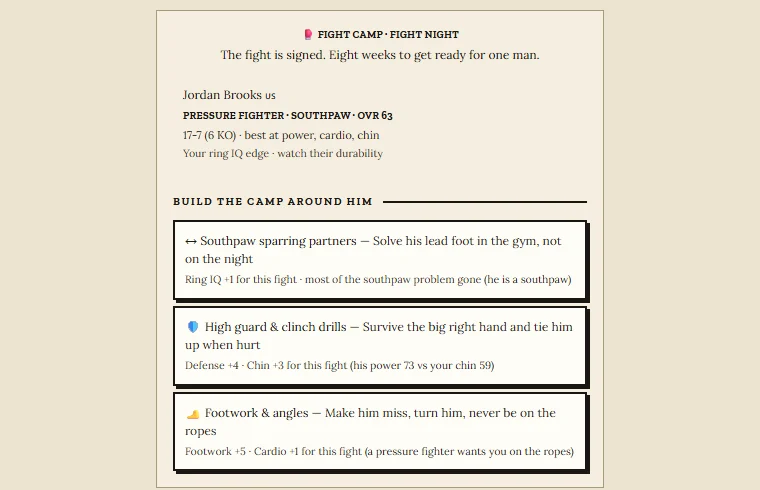
- The cutman. Never hiring one made no visible difference over 200 careers. He matters on the night you are cut, and those nights are rare.
- Turning pro late. Waiting until the last possible moment, around 25 instead of 18 or 19, meant arriving much stronger, with about eight points more rating, and taking far less damage over a career. But it also meant about four fewer professional wins (11 against 15), and the title rate came out slightly lower, 19% against 22%. It is a trade, not a mistake.
How a career goes wrong
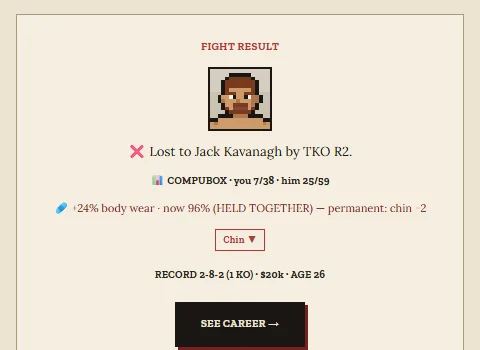
The screenshot above came from one of our own test runs, a bot that took fights and never trained. Notice the damage line. Wear builds up with every fight and heals with rest, but some of it never comes back: the game records permanent damage, and a boxer who keeps fighting worn starts to lose his chin for good. Once that happens, losses come faster, and four in a row is the end.
A simple plan for your next career
- Pick the prospect whose potential you like, and do not overthink it.
- In the amateurs, take the options that build the stats your style needs.
- Turn pro when it feels right; there is no wrong answer between 18 and 25.
- As a pro, train in every block you can afford, and fight in the rest.
- Take the favoured fights while you are improving. Step up when the numbers say you are ready.
- Move weight class when the cut gets serious.
- After two straight losses, take the safest fight on the card.
- When the title shot comes, take it.
Follow that and you should hold a belt about one career in five, which is roughly where we have tuned the game to be. If you want to know why we made it that hard, we wrote about it in designing Boxing Career.
Prefer to run the business side? In Boxing Manager you pick the fights for a whole stable of real boxers, and the same lesson applies: the safest choice is not always the smart one. We ran 200 careers of that game too.
Frequently asked questions
- How do you become world champion in Boxing Career?
- Train between fights and choose opponents you are likely to beat while you climb. In our test runs a sensible player becomes world champion in about one career in five; a player who never trains gets there about one time in fifty.
- Should I train or fight in Boxing Career?
- Train. A fight sharpens one attribute and wears another, so on its own it barely moves your rating. Training is the only reliable way to raise it, and boxers who never train peak about eleven points lower.
- Does it matter which prospect I pick in Boxing Career?
- Less than you might think. Picking the prospect with the most potential raised the peak rating by about two points in our runs, but did not change how often careers ended with a world title.
- How does a career end in Boxing Career?
- You can retire whenever you like. The game also ends a career after four straight defeats or at age 38, so a run of reckless fights can finish you long before your prime is over.
- Should I change weight class in Boxing Career?
- Yes, when the cut becomes hard. Boxers who never changed division missed weight about seven times as often, and each miss costs a fifth of the purse.