From the workshop
Designing a Boxing Career Game Where Most Careers Never Win a Belt
Notes from building a boxing life sim in a single web page: the numbers we tune against, the ideas we threw out, and why the belt has to be hard to win.
A career game has one easy way to fail: hand out the championship. If you pick a prospect, press train a few dozen times and are world champion by 26 on every run, the belt stops meaning anything by the second go. It is not something you won; it is something the game gave you at the end. This is how we try to keep Boxing Career hard, and of the numbers we now check every time we change a line of the game.
The target: one belt in five
Real boxing is a pyramid with a very narrow top. Thousands of amateurs turn professional; a small fraction ever fight for a world title; fewer win one. We did not want to copy that ratio exactly (nobody plays a game that says no ninety-nine times in a hundred), but we wanted a world title to feel like the result of a career, not a checkpoint on the way to the credits.
So we set a target before writing any new content: a player who makes sensible decisions should become world champion roughly 20 to 25 percent of the time. A player who clicks at random should get there about 3 percent of the time. A player who makes every bad choice should retire with an F.
We check those numbers with a test harness that plays the actual game code, not a model of it. It runs 25 complete careers each for three policies: a “best” player who trains, rests and chooses fights sensibly; a random clicker; and a worst-case player. Here is the run from the day this post was written:
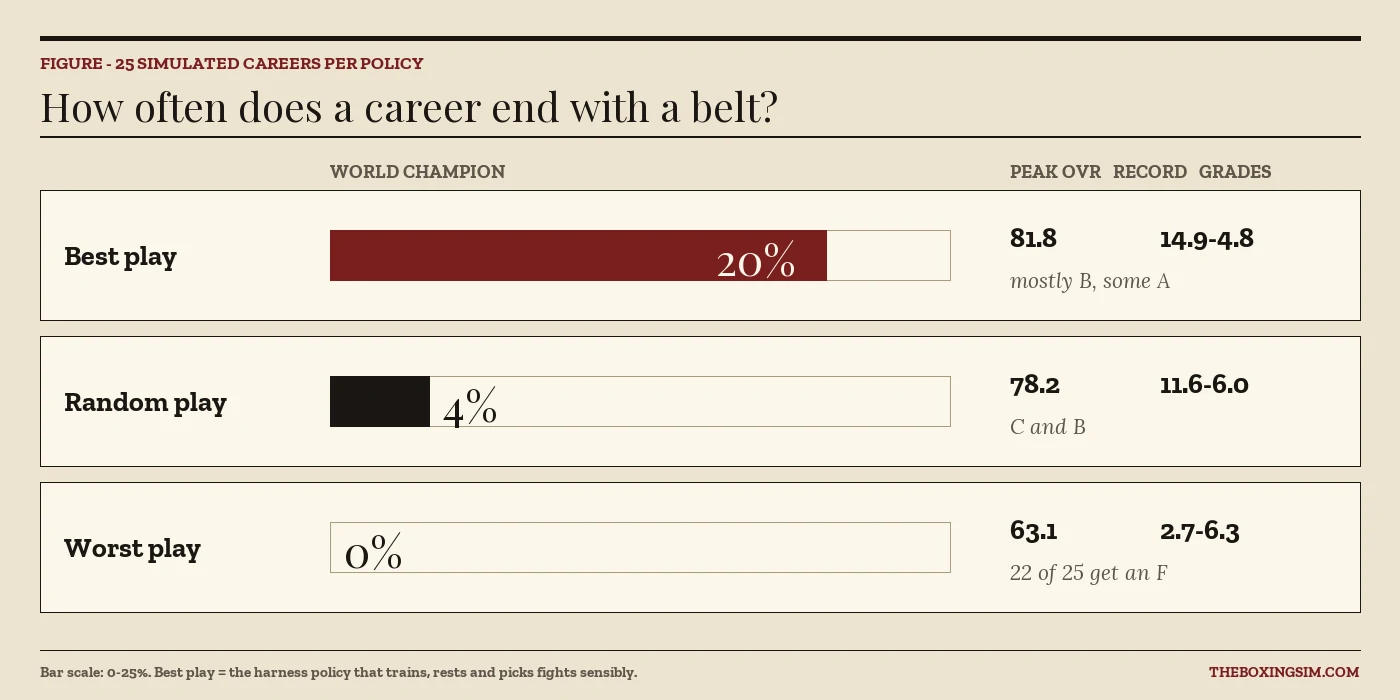
Two things in that chart matter more than the headline. First, the good player’s peak rating (81.8) is only a few points higher than the random player’s (78.2). Skill in this game is not about grinding a bigger number. It is about when you fight, whom you fight and what shape you are in when you do. Second, the best player still loses almost five fights a career. Losing is part of a boxing life, and the game treats a loss as a chapter, not a game over.
Why the old version was too easy
The fight model compares the two boxers stat by stat. In the first version, the Boxing stat (technique) was worth half a point of advantage per point of difference, while Speed and Defence were worth a quarter each. That sounds harmless. In practice it meant the only sensible career was to pour every training session into Boxing and ignore everything else. Defence, which could be trained to 99, was worth less than half of what the same effort in Boxing gave you.
The fix was to re-price every stat so that no single one dominates. Per point of difference in the current model, Boxing and Footwork are each worth about 0.30, Speed and Defence 0.26, Chin and Cardio 0.35, Power 0.45 and Ring IQ 0.50. Defence also gets a second job: it reduces the chance of being stopped. The effect is that a balanced boxer beats a one-stat boxer, and your choices in training actually shape the kind of fighter you become.
We also derive one quality instead of training it directly. Pressure, the ability to walk an opponent down for twelve rounds, is calculated from Power, Cardio and Chin. You cannot buy it; you can only build the body that produces it.
Growing up before turning pro
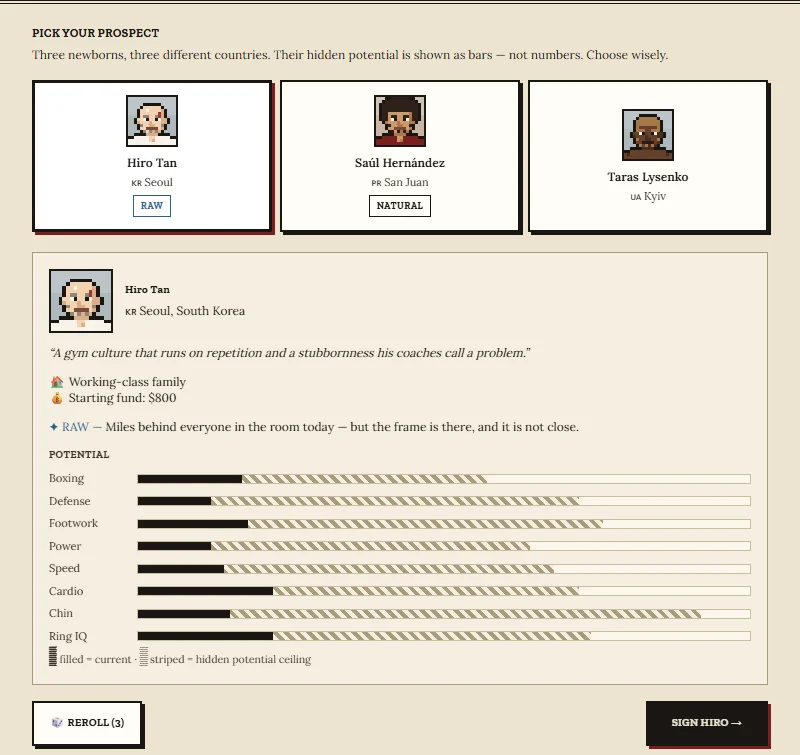
Most boxing games start at the first professional fight. We start in childhood, because that is where boxing styles come from. Your prospect grows up through a string of small decisions: whether to join the boxing class or keep it in the streets, whether to carry sacks at the market for money or run the fields at dawn, whether to meet the kid who insulted you behind the gym or train angrier. Each choice nudges one or two stats and sometimes opens a story thread later on.
One of those threads is the old coach. Most prospects are taken into a gym by an older trainer who charges nothing. He appears through the whole career, has something to say before big fights, and, because he is old, he may not be there at the end. We added him because the best boxing stories are rarely about the champion alone, and because it gives a win in the late thirties a reason to matter.
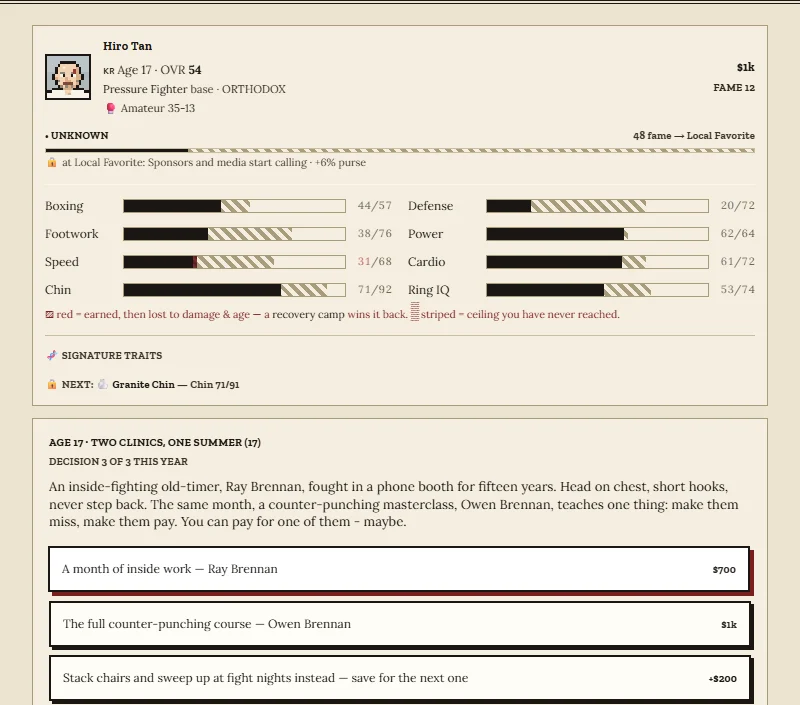
The most recent addition is paid clinics. Twenty specialist coaches, each teaching one or two things, turn up in the amateur years with a price attached. A young boxer from a working-class family cannot afford all of them. You can work a shift instead, sit in on one session for a fraction of the cost, or take the course on credit and repay it from your first professional purses. It is a small system, but it introduces the idea that talent needs money to develop, which is true of the sport and makes your starting family matter.
Fight camps built around one man
Once you are a professional, every fight is preceded by a camp. The game offers three ways to prepare, each written for that specific opponent: if he is a southpaw, you can bring in southpaw sparring partners; if his chin has been cracked before, you can do power sparring; you can always study his last five fights. Each option gives a boost for this fight only, and it is the most frequent important decision in a professional career.
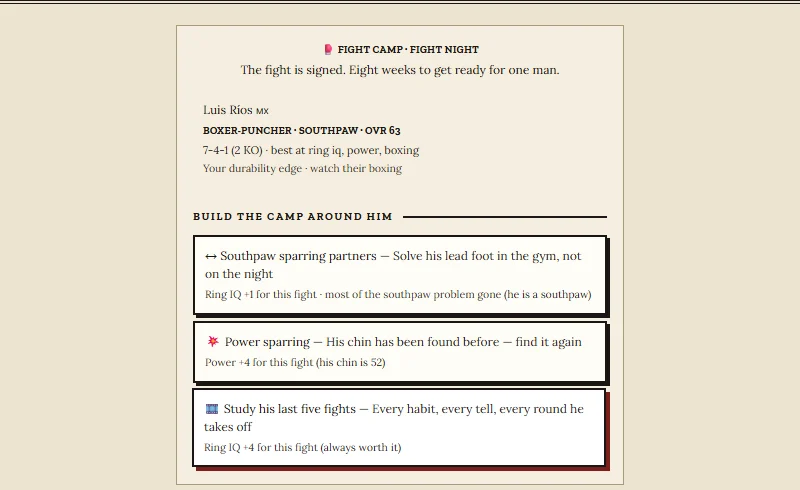
A generic “train harder” button would have one right answer every time. Tying the camp to the opponent turns every fight into a small puzzle: what is his best weapon, and what is mine?
Wear, weight and the body that pays for it
A boxing career is limited less by skill than by the body. Every fight adds wear. Wear takes points off your Chin and Cardio until you rest, and the stat bars show it in red: earned, then lost to damage and age. A recovery camp wins some of it back; fighting too often never does.
Weight is the other slow tax. Your boxer grows, and staying in a lighter division means cutting. On the morning of a weigh-in the game can tell you that you are three pounds over, with two hours to make it. Cut the weight and you enter the ring drained. Miss it and you forfeit a fifth of the purse but keep your strength. Neither answer is always right, which is exactly what makes it a good decision.
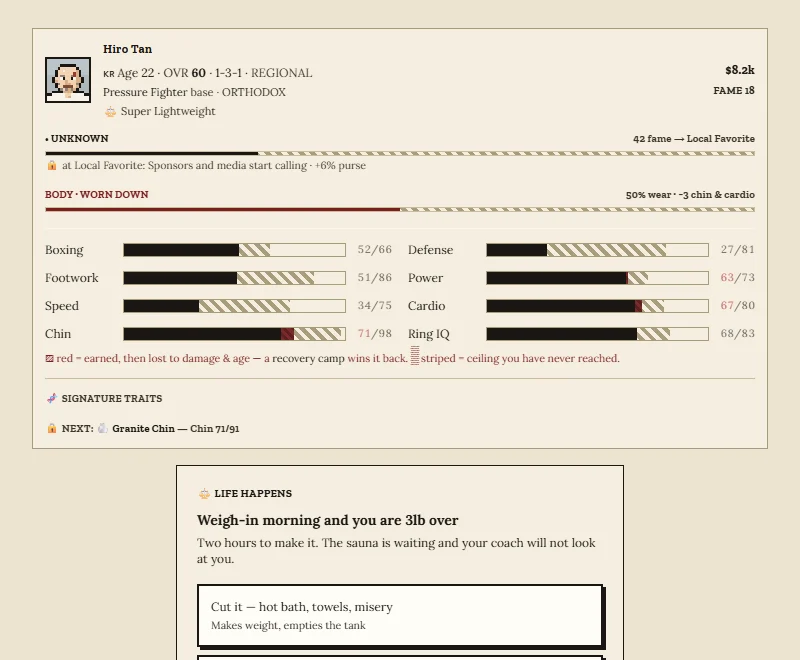
In the test runs the random player misses weight nearly twice per career on average and is still cutting through two and a half divisions at retirement. The best player moves up about twice, misses weight far less, and fights at a natural size. That single habit explains a large part of the gap between them.
Fights you watch, scorecards you can read
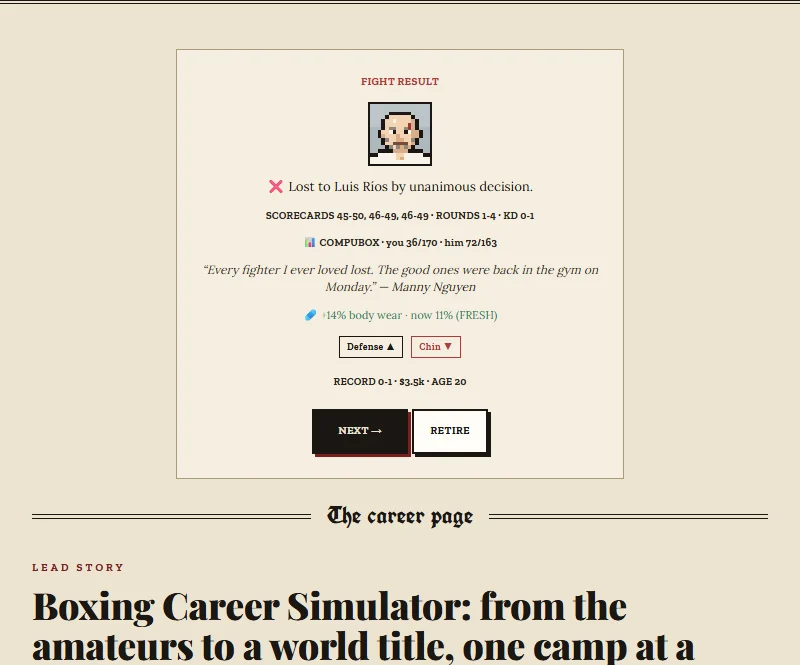
The fights use the same ideas as our boxing simulator: three judges scoring every round on the 10-point must system, knockdowns worth 10-8, cuts that can bring in the doctor, corners that can pull a boxer out between rounds, and fouls. You can watch round by round or skip to the result. Either way you get the three scorecards and a punch count at the end, so a close loss comes with an explanation rather than a shrug. (If you want to know how those cards work, we wrote about how boxing is scored.)
Real names, earned
For the first stretch of a career every opponent is fictional: prospects, journeymen, the local rival. Real boxers from our roster of more than 300 only start to appear once you are ranked. When they do, their ratings are scaled to the level of that slot in your career, so a famous name is a sign of how far you have come, not an unwinnable wall. And when you retire, the game compares your record and style with the whole roster and tells you which real boxer your career most resembled.
What we cut
- Money with nowhere to go. Purses once piled up and did nothing. Money now pays for clinics, cutmen and camps, and three bugs where purses were counted wrongly have been fixed along the way.
- Endless grinding. Stats have ceilings set at birth, shown as the striped part of each bar, and time spent fighting is time spent ageing.
- Guaranteed titles. See the chart above. If a belt is certain, it is not a belt.
Play it, then tell us what felt wrong
Every number in this post will move. When we add a system, the harness runs again, and if the best player starts winning titles 40 percent of the time, something gets harder. If you finish a career that felt unfair, or too easy, that is exactly the feedback we want through the contact page.
If you would rather be the one picking the fights, Boxing Manager puts you on the other side of the table, managing a stable of real boxers through offers, purses and mandatories.
Frequently asked questions
- How long does a Boxing Career run take?
- About five minutes for a full career, from choosing a prospect as a child to retirement. The game saves in your browser, so you can stop and come back.
- How often do players win a world title in Boxing Career?
- In our test runs a sensible, well-played career becomes world champion about one time in five. Random choices win a belt about one time in twenty-five, and careless play almost never does.
- Which stat matters most in Boxing Career?
- None on its own. Every stat is worth something in the fight model, and Ring IQ is worth the most per point, but a boxer built on one stat is easy to beat. Chin and cardio decide the late rounds.
- Do you fight real boxers in Boxing Career?
- Early fights are against fictional prospects and journeymen. Once your boxer is ranked, real boxers from our roster of over 300 start to appear as opponents, scaled to your level.
- Is Boxing Career free?
- Yes. It runs in any browser on phone or PC, with no download, account or payment.