From the workshop
Why the Safe Boxing Manager Goes Broke: 200 Simulated Careers
Winning is not enough. Two hundred simulated careers show why the cautious manager runs out of money, why greed works better than it should, and what a good manager does instead.
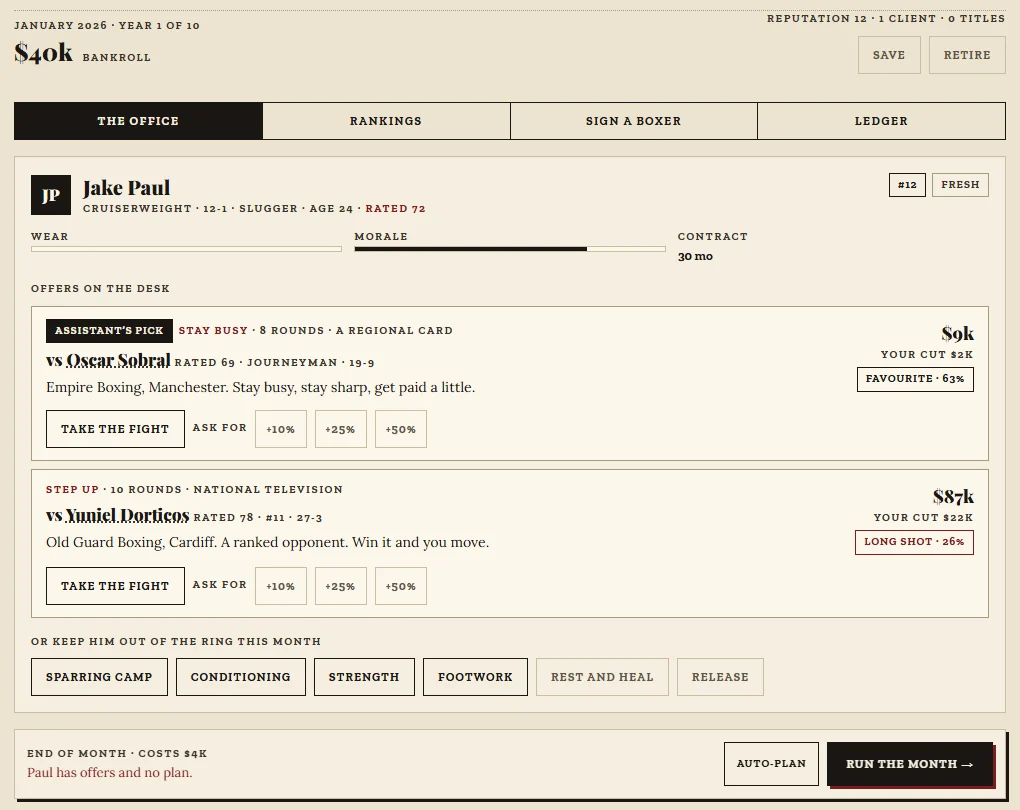
Every new player of Boxing Manager makes the same first decision. Your one boxer has two offers on the desk: a stay-busy fight against a journeyman he should beat, and a step up against a ranked man who might beat him. The safe fight feels like good management. You protect the record, you collect a purse, you build slowly. We wanted to know where that instinct leads over ten years, so we let the computer play the game two hundred times and kept the books.
The experiment
Boxing Manager has a test harness that runs the real game code, the same file your browser loads, without the screen. It starts a new office with $40,000 and one ranked boxer, plays a full ten years one month at a time, and checks that the world stays consistent after every month. We gave it five managers to play and ran each one forty times:
- The careful manager takes any title fight on offer, and otherwise picks the fight with the best purse once the chance of winning is taken into account. He rests boxers who are worn and signs good free agents and promising prospects when he can afford them.
- The biggest-purse manager takes the most money on the desk every month, no matter whom it is against.
- The assistant is the game’s own auto-plan button, pressed every month.
- The safe manager only ever takes stay-busy fights against journeymen.
- The coin-flipper takes a random offer, or none, without looking.
The results
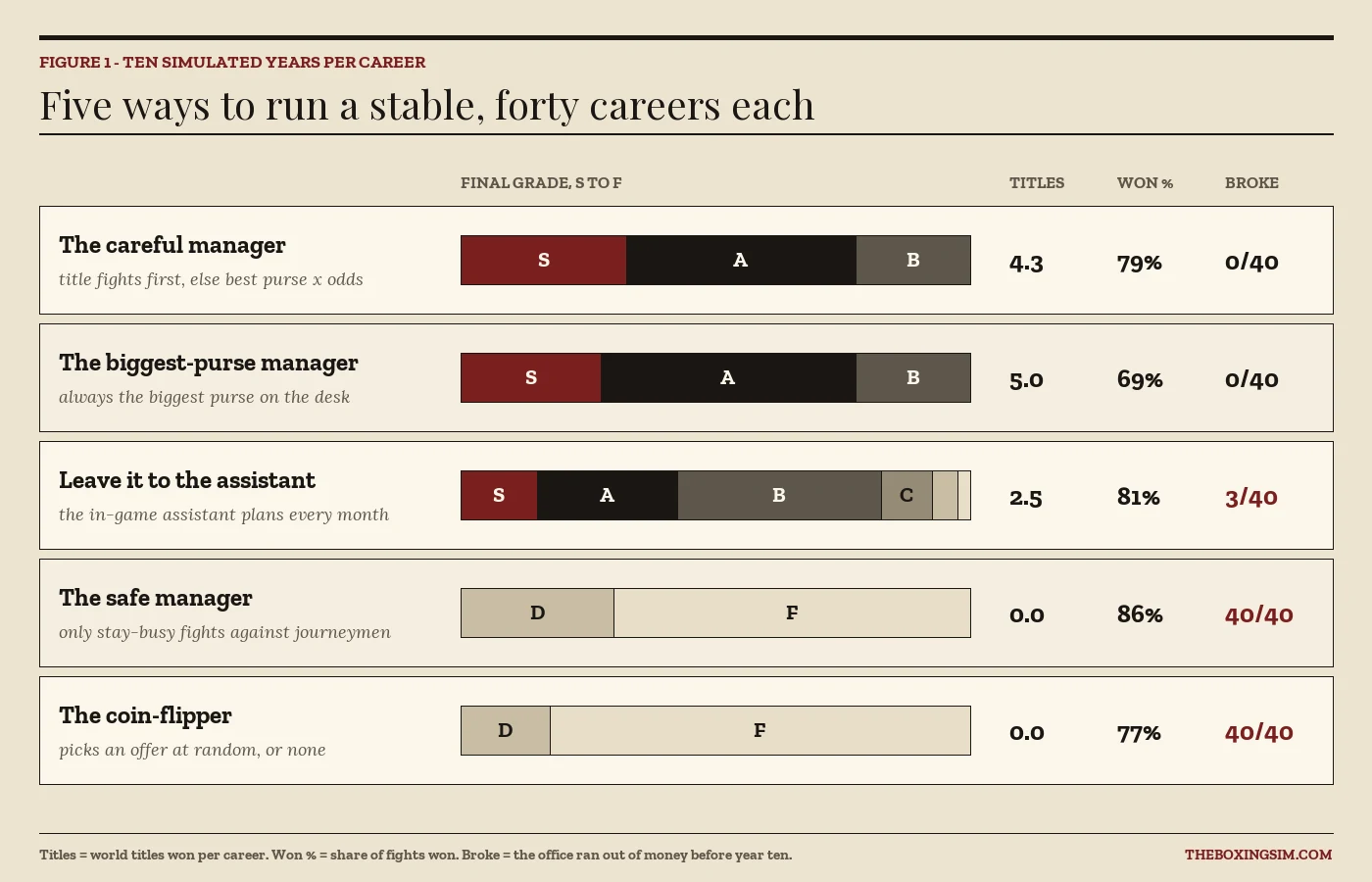
Look at the win rates first. The safe manager’s boxers won 86% of their fights, more than any other strategy. He also went broke in 40 careers out of 40, on average before the end of his fourth year. The coin-flipper lasted a little longer, about four and a half years, and also never reached year ten.
At the other end, the careful manager and the biggest-purse manager never went broke at all. Both finished with an A or S grade about three times in four. The careful manager’s boxers won 79% of their fights and he banked the most money; the greedy one won only 69% but collected the most world titles, five per career.
Why winning is not enough
The answer is in the office’s monthly bill, and it is deliberately simple. Rent, phones and a trainer’s retainer cost $2,500 a month. Each boxer costs another $1,200 in gym time and a cutman. You take 25% of every purse. With one boxer that is $3,700 going out every month, fight or no fight.
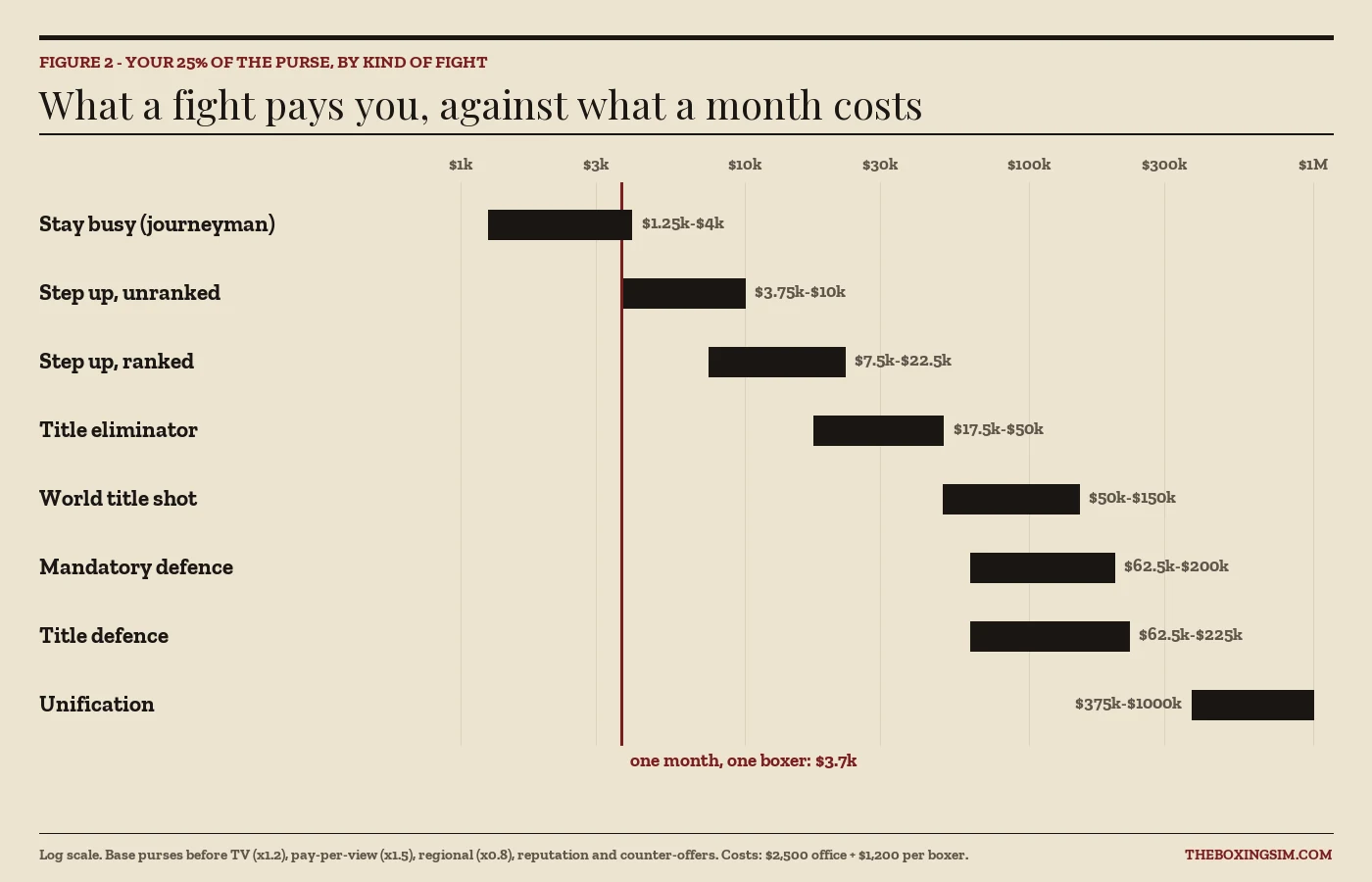
A stay-busy fight pays a purse of $5,000 to $16,000, less on a regional card. Your quarter is $1,250 to $4,000, which at best covers a single month. But a boxer cannot fight every month: he needs time to recover, and wear builds up with every fight. So the safe manager pays the bill every month and earns it back only some of the time. His boxers keep winning and his bank balance keeps falling, until the office is $60,000 in the red and the game ends.
Everything above the stay-busy fight changes that arithmetic. A ranked step up pays your share of $7,500 to $22,500. A world title shot pays $50,000 to $150,000, enough to run the office for over a year. A unification pays a six-figure share. The business of boxing management is not winning fights. It is getting your boxers into the fights that pay, and winning enough of those.
This is true of the real sport too. A fighter who stays busy on small shows can build a beautiful record and still need a day job. The money is concentrated at the top, in television dates, title fights and pay-per-view, and a manager’s job is to move a boxer up toward it before his best years run out.
Why greed works better than it should
We expected the biggest-purse manager to be punished. He takes fights his boxers are not ready for, loses almost one in three, and still finishes with the most titles. Why?
Because in boxing the biggest purse on the desk is usually a title fight. Taking it every time means taking every title shot, every unification and every big defence that comes along. Some of those he loses, but the losses are survivable: a beaten contender drops a few places and the offers keep coming, and the purse is paid either way. Meanwhile each win is worth a belt and the bigger offers that follow.
What greed costs him is money over time. The careful manager finishes ten years with an average bankroll of about $8.3 million; the greedy one with about $6.0 million. Losses cost purses in later fights, worn boxers need longer rests, and a stripped or lost belt takes its defences with it. The grades come out almost level because the game rewards ambition. We think that is right. A manager who aims high and sometimes loses should finish ahead of one who never risks anything.
What the careful manager does differently
The best strategy in our test is not complicated, and it is the one we would recommend to a new player:
- Say yes to title fights. Title shots, mandatories and unifications are where both the points and the money are. Even an underdog shot is usually worth taking.
- Otherwise, price the risk. For any other offer, think about the purse multiplied by the chance of winning. A $90k step up at 40% is worth more than a $16k stay-busy fight at 85%. The game shows the odds on every offer; use them.
- Rest worn boxers. Every fight adds wear, and wear comes straight off a boxer’s rating on fight night: a man at half wear fights about five points below himself. A month off is cheaper than a lost ranking.
- Grow the stable when you can afford it. More boxers means more fights and more purses each month, and each costs only $1,200. A good prospect signed cheaply can be your champion five years later.
- Do not let mandatories lapse. A champion who ducks his mandatory challenger is stripped, and the belt goes to the man he avoided.
About the assistant
The auto-plan button is there for players who want to manage the big decisions and let the routine ones look after themselves. It is careful by design: it never takes a fight it expects to lose unless it is a title fight, and it rests anyone too worn to fight. That makes it decent, with 2.5 world titles per career and mostly B and A grades, but not as good as a thinking player. In three careers out of forty it ran the office into the ground. The harness checks this on every run: if the assistant ever starts beating the careful strategy, the test fails, because a game that plays itself better than you can is not much of a game.
A bug the experiment found
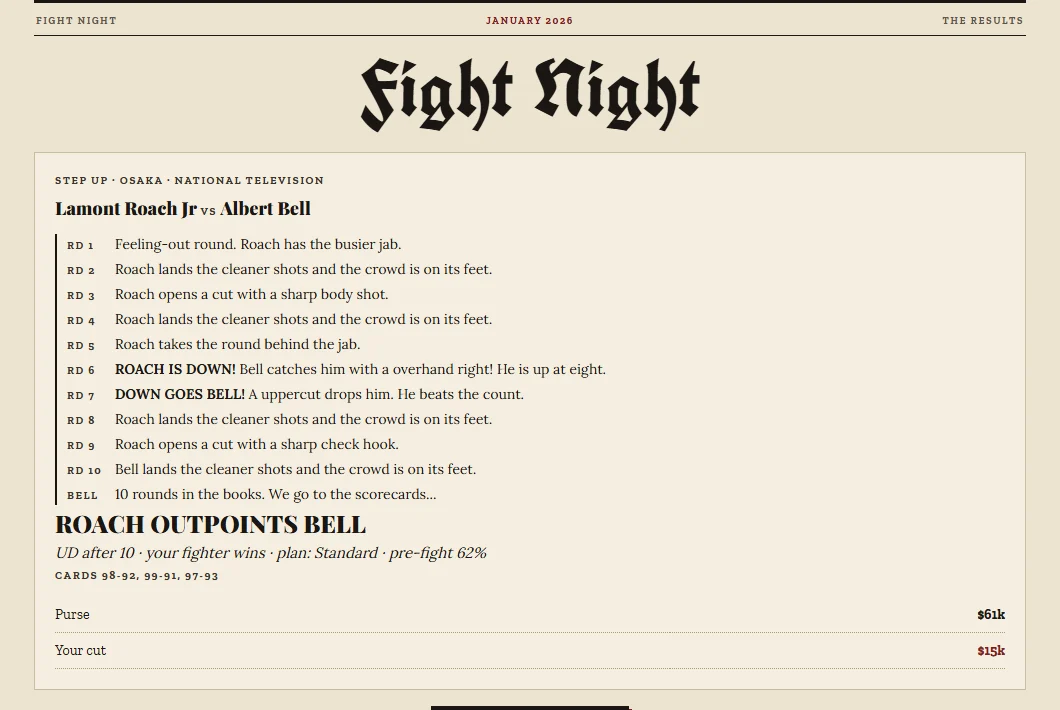
Running two hundred careers is also the best bug hunt we have. While collecting the numbers for this article, the harness stopped with an error: a boxer who had retired was still in the rankings. The cause was rematches. If your boxer lost a close decision, the game remembered the opponent for a rematch, and the rematch offer did not check whether that opponent had retired in the meantime. Take the fight, and a retired man walked back into the top fifteen. Both that offer and the rankings update now refuse retired boxers, and the fix went live the same morning. It is a small example of why we test the real game code and not a simplified model of it.
Run the office yourself
None of these strategies is the game played well. They are blunt rules, and a human who reads the offers, counters the purse, plans each camp and times each rest will do better than any of them. But the lesson of the experiment holds for every player: in Boxing Manager, the most expensive fight is often the one that looks safe.
If you would rather be in the ring than behind the desk, Boxing Career puts you in the gloves, and we wrote about how that game is balanced too. The fights in both games run on the engine we tested against 179 real results.
Frequently asked questions
- What is the best strategy in Boxing Manager?
- Take title fights whenever they come, and otherwise pick the offer with the best purse for the risk, not simply the biggest or the safest. In our test runs that approach never went broke and finished with an A or S grade in 31 of 40 careers.
- Why do I keep going broke in Boxing Manager?
- The office costs $2,500 a month plus $1,200 for every boxer you manage, and your share of a stay-busy fight is only $1,250 to $4,000. A stable that only takes small, safe fights loses money every month. You need ranked fights and title fights to pay the bills.
- Is the auto-plan assistant good in Boxing Manager?
- It is decent but deliberately not the best. In our runs the assistant won 2.5 world titles per career against 4.3 for a careful human strategy, and it went broke in 3 of 40 careers.
- How long is a game of Boxing Manager?
- Ten in-game years, one month per turn: 120 months if your office survives that long. The game saves in your browser, so a run can be spread over several sittings.
- How is the final grade worked out?
- Points for wins, eliminators, world titles, defences and milestones, minus points for losses, lapsed mandatories and stripped belts, plus a share of the total purses your boxers earned. The grades run from F to S, Hall of Fame.