Reference
Boxing Weight Classes
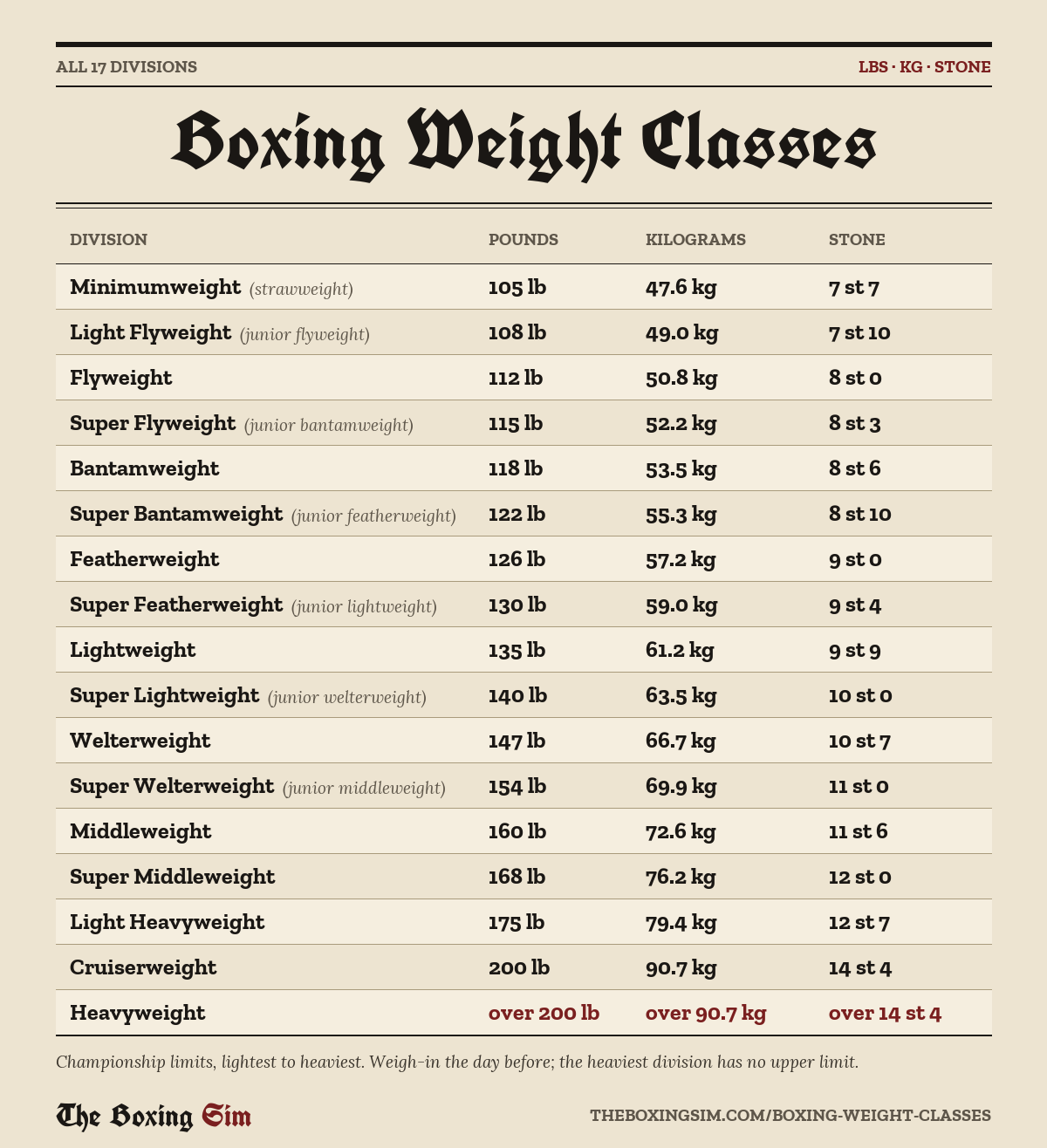
All seventeen divisions, from minimumweight to heavyweight, with every limit in pounds, kilograms and stone, the champion of each in the simulator, and a calculator that tells you where any weight lands.
All 17 boxing weight classes in order
| Division | Limit (lb) | kg | Stone | Range (lb) | Range (kg) | Champion |
|---|---|---|---|---|---|---|
| Minimumweight strawweight | 105 | 47.6 | 7 st 7 | 1–105 | 0.5–47.6 | Oscar Collazo |
| Light Flyweight junior flyweight | 108 | 49.0 | 7 st 10 | 106–108 | 48.1–49.0 | Rene Santiago |
| Flyweight | 112 | 50.8 | 8 st 0 | 109–112 | 49.4–50.8 | Ricardo Sandoval |
| Super Flyweight junior bantamweight | 115 | 52.2 | 8 st 3 | 113–115 | 51.3–52.2 | David Jimenez |
| Bantamweight | 118 | 53.5 | 8 st 6 | 116–118 | 52.6–53.5 | Jesse Rodriguez |
| Super Bantamweight junior featherweight | 122 | 55.3 | 8 st 10 | 119–122 | 54.0–55.3 | Naoya Inoue |
| Featherweight | 126 | 57.2 | 9 st 0 | 123–126 | 55.8–57.2 | Rafael Espinoza |
| Super Featherweight junior lightweight | 130 | 59.0 | 9 st 4 | 127–130 | 57.6–59.0 | Emanuel Navarrete |
| Lightweight | 135 | 61.2 | 9 st 9 | 131–135 | 59.4–61.2 | Raymond Muratalla |
| Super Lightweight junior welterweight | 140 | 63.5 | 10 st 0 | 136–140 | 61.7–63.5 | Shakur Stevenson |
| Welterweight | 147 | 66.7 | 10 st 7 | 141–147 | 64.0–66.7 | Devin Haney |
| Super Welterweight junior middleweight | 154 | 69.9 | 11 st 0 | 148–154 | 67.1–69.9 | Jaron Ennis |
| Middleweight | 160 | 72.6 | 11 st 6 | 155–160 | 70.3–72.6 | Carlos Adames |
| Super Middleweight | 168 | 76.2 | 12 st 0 | 161–168 | 73.0–76.2 | Osleys Iglesias |
| Light Heavyweight | 175 | 79.4 | 12 st 7 | 169–175 | 76.7–79.4 | Dmitry Bivol |
| Cruiserweight | 200 | 90.7 | 14 st 4 | 176–200 | 79.8–90.7 | Jai Opetaia |
| Heavyweight | none | — | — | over 200 | over 90.7 | Oleksandr Usyk |
Championship limits, lightest to heaviest · old names in italics · champions as rated in the simulator
The limits are set in pounds. Kilograms, used in amateur and Olympic boxing and by most of the world, and stone, still how British and Irish boxing talks about weight, are conversions: a welterweight makes 147 lb, which is 66.7 kg or 10 st 7. The numbers fans quote are the limits themselves, so 130 is super featherweight, 135 lightweight, 140 super lightweight, 147 welterweight, 154 super welterweight and 160 middleweight; one pound over and a fighter is in the class above. That is why an 80 kg boxer, a shade over the 79.4 kg light heavyweight limit, is a cruiserweight.
The older names in italics are still on posters and in the record books, and the sanctioning bodies do not all use the same ones: the WBA and IBF say junior welterweight where the WBC says super lightweight, for the same 140 lb.
Boxing weight classes chart
What weight class am I?
Enter a weight in pounds, kilograms or stone. The matching row in the table above is highlighted.
Remember that boxers weigh in the day before and rehydrate: the number on the scale at the weigh-in is usually ten to fifteen pounds under what they weigh at the first bell. How the fight is then scored is in How Boxing Is Scored.
The women’s divisions
| Division | Limit | Champion |
|---|---|---|
| Minimumweight | 105 lb | Yokasta Valle |
| Light Flyweight | 108 lb | — |
| Flyweight | 112 lb | — |
| Super Flyweight | 115 lb | — |
| Bantamweight | 118 lb | — |
| Super Bantamweight | 122 lb | — |
| Featherweight | 126 lb | Amanda Serrano |
| Super Featherweight | 130 lb | — |
| Lightweight | 135 lb | Caroline Dubois |
| Super Lightweight | 140 lb | — |
| Welterweight | 147 lb | Lauren Price |
| Super Welterweight | 154 lb | — |
| Middleweight | 160 lb | — |
| Super Middleweight | 168 lb | Lani Daniels |
| Light Heavyweight | 175 lb | — |
| Cruiserweight | 200 lb | — |
| Heavyweight | no limit | — |
Same seventeen limits as the men · women’s title fights are ten rounds of two minutes
Every division, in detail
Minimumweight
105 lb · 47.6 kg · 7 st 7Also called strawweight or mini-flyweight. The smallest division in the sport, created in 1987 and fought almost entirely in Asia and Latin America; a great minimumweight is quick, tireless and rarely a puncher.
Champion in the simulator: Oscar Collazo · Women’s: Yokasta Valle · Simulate a minimumweight fight →
Light Flyweight
108 lb · 49.0 kg · 7 st 10Junior flyweight. A step up from the minimum limit that has produced some of the longest reigns in boxing history, and a division where speed and work rate decide most nights.
Champion in the simulator: Rene Santiago · Simulate a light flyweight fight →
Flyweight
112 lb · 50.8 kg · 8 st 0The oldest of the small divisions, a world title since 1913. Flyweights fight at a pace heavyweights could not hold for a round, and the best of them have moved up and won at 115 and 118.
Champion in the simulator: Ricardo Sandoval · Simulate a flyweight fight →
Super Flyweight
115 lb · 52.2 kg · 8 st 3Junior bantamweight. The busiest of the lighter divisions in the modern era, with a run of great fighters and great fights that made it a television staple.
Champion in the simulator: David Jimenez · Simulate a super flyweight fight →
Bantamweight
118 lb · 53.5 kg · 8 st 6A championship weight since the 1880s, and the division where the smaller men start to carry real power. Naoya Inoue made it the most watched small-man division in the world.
Champion in the simulator: Jesse Rodriguez · Simulate a bantamweight fight →
Super Bantamweight
122 lb · 55.3 kg · 8 st 10Junior featherweight. Four pounds above bantam, and lately the home of the best pound-for-pound fighter in the sport.
Champion in the simulator: Naoya Inoue · Simulate a super bantamweight fight →
Featherweight
126 lb · 57.2 kg · 9 st 0One of the eight original weight classes. Featherweight has always mixed pure boxers with pressure fighters, and the great ones have usually been able to do both.
Champion in the simulator: Rafael Espinoza · Women’s: Amanda Serrano · Simulate a featherweight fight →
Super Featherweight
130 lb · 59.0 kg · 9 st 4Junior lightweight. A four-pound bridge to lightweight that has been a proving ground for fighters on the way up and a last stop for fighters who could not make 126 any more.
Champion in the simulator: Emanuel Navarrete · Simulate a super featherweight fight →
Lightweight
135 lb · 61.2 kg · 9 st 9The glamour division of the lower weights, with the deepest history in the sport: Leonard, Duran, Whitaker, De La Hoya, Mayweather and Lomachenko all held the title.
Champion in the simulator: Raymond Muratalla · Women’s: Caroline Dubois · Simulate a lightweight fight →
Super Lightweight
140 lb · 63.5 kg · 10 st 0Junior welterweight. Ten pounds above lightweight in stature, five in name; a division of fast, heavy-handed fighters who tend to make great fights with each other.
Champion in the simulator: Shakur Stevenson · Simulate a super lightweight fight →
Welterweight
147 lb · 66.7 kg · 10 st 7Robinson, Leonard, Hearns, Mayweather, Pacquiao. Welterweight has produced more pound-for-pound arguments than any other weight, and the belt at 147 is still the one every 140-pounder wants.
Champion in the simulator: Devin Haney · Women’s: Lauren Price · Simulate a welterweight fight →
Super Welterweight
154 lb · 69.9 kg · 11 st 0Junior middleweight. The division where welterweights go when they grow, and a place that has quietly produced some of the best fights of the last decade.
Champion in the simulator: Jaron Ennis · Simulate a super welterweight fight →
Middleweight
160 lb · 72.6 kg · 11 st 6The classic weight. Greb, Robinson, Monzon, Hagler, Hopkins, Golovkin. Middleweights are big enough to end a fight with one punch and small enough to fight twelve rounds at pace.
Champion in the simulator: Carlos Adames · Simulate a middleweight fight →
Super Middleweight
168 lb · 76.2 kg · 12 st 0Created in 1984 and now one of the deepest divisions in boxing, with the undisputed championship the sport’s biggest prize below heavyweight.
Champion in the simulator: Osleys Iglesias · Women’s: Lani Daniels · Simulate a super middleweight fight →
Light Heavyweight
175 lb · 79.4 kg · 12 st 7A championship weight since 1903 and the natural home of the fighter who is too big for 168 and too small to give away thirty pounds at heavyweight. Moore, Foster, Spinks, Jones and Bivol all ruled it.
Champion in the simulator: Dmitry Bivol · Simulate a light heavyweight fight →
Cruiserweight
200 lb · 90.7 kg · 14 st 4The newest of the major divisions, introduced in 1979 for the men between light heavyweight and the giants. Holyfield and Usyk went from undisputed cruiserweight champion to heavyweight champion of the world.
Champion in the simulator: Jai Opetaia · Simulate a cruiserweight fight →
Heavyweight
no limitNo limit. The champion of the world, historically the most famous athlete alive. Modern heavyweights weigh 220 to 270 pounds, which is why the simulator treats 235 as the division’s working weight when it prices a cross-division fight.
Champion in the simulator: Oleksandr Usyk · Simulate a heavyweight fight →
Questions from the mailbag
- How many weight classes are there in boxing?
- Seventeen, from minimumweight at 105 lb to heavyweight with no limit. The four major sanctioning bodies (WBA, WBC, IBF, WBO) all recognise the same seventeen, though some use older names: junior flyweight for light flyweight, junior welterweight for super lightweight, and so on.
- What is the heaviest weight class in boxing?
- Heavyweight, which has no upper limit. Anyone over the 200 lb cruiserweight limit is a heavyweight; modern champions weigh between 220 and 270 lb.
- What is the lightest weight class in boxing?
- Minimumweight, also called strawweight or mini-flyweight, with a limit of 105 lb (47.6 kg).
- Do boxers fight at their weight-class limit?
- No. Boxers weigh in the day before the fight at or under the limit, then rehydrate; by the opening bell a middleweight who weighed 160 lb is often 175 or more. That is why giving away a division or two matters less than the numbers suggest and giving away four or five matters more.
- What is heavyweight in boxing in stone?
- Heavyweight has no upper limit: anyone over the cruiserweight limit of 14 st 4 (200 lb) is a heavyweight. Modern heavyweight champions weigh roughly 15 st 10 to 19 st 4 (220 to 270 lb).
- What is the junior welterweight weight limit?
- Junior welterweight is the old name for super lightweight: 140 lb, 63.5 kg or 10 st. Junior middleweight (super welterweight) is 154 lb, 69.9 kg or 11 st.
- What are the boxing weight classes in order?
- Lightest to heaviest: minimumweight (105 lb), light flyweight (108), flyweight (112), super flyweight (115), bantamweight (118), super bantamweight (122), featherweight (126), super featherweight (130), lightweight (135), super lightweight (140), welterweight (147), super welterweight (154), middleweight (160), super middleweight (168), light heavyweight (175), cruiserweight (200) and heavyweight (no limit).
- What weight class is 154 in boxing?
- 154 lb (69.9 kg) is the super welterweight limit, also called junior middleweight. 130 lb is super featherweight, 135 lb lightweight, 140 lb super lightweight, 147 lb welterweight, 160 lb middleweight and 168 lb super middleweight. In kilos, 80 kg is just over the light heavyweight limit of 79.4 kg, so an 80 kg boxer is a cruiserweight.
- Why are there so many divisions?
- Boxers are matched by weight because size is the biggest single advantage in the sport. The eight original divisions were spaced too far apart for men who could not safely make one limit and gave away too much at the next, so the junior and super divisions were added between them through the twentieth century.
On the same paper
Pick a division and settle any fight in the boxing simulator, raise a fighter through it in the career mode, or browse the whole shelf of free boxing games, with pages on playing where games are blocked, on a phone and on a PC.