Boxing, explained
How Boxing Is Scored: The 10-Point Must System Explained
Three judges, twelve boxes each and one pencil: what earns a round, what a knockdown really costs, and how three cards turn into a unanimous, split or majority decision.
Three people sit at the edge of the ring, one on each of three sides, each with a pencil and a card that has a box for every round. They do not talk to each other, they do not see a replay, and they do not know how the other two are scoring. When the final bell goes their cards are collected and totalled, and one of the most argued-about moments in sport begins. This is how that card works, from the single round up to the verdict.
The short version
- Every round is scored on its own, by three judges, independently.
- The winner of a round gets 10 points, the loser 9. That is the “must”: somebody must get 10.
- A knockdown usually costs a point on top: 10-8. Two knockdowns: 10-7.
- Fouls can cost a point too, taken off by the referee, not the judges.
- Each card is added up at the end. Win two of the three cards and you win the fight.
Where the 10-point must system came from
For much of the twentieth century boxing had no single way of scoring. Some places simply counted rounds won, some used five-point systems, some let the referee score the fight as well as run it. The 10-point must system spread through American and then world boxing because it does something the round-count cannot: it lets a judge record not just who won a round, but by how much. A round in which one boxer was knocked flat is not the same as a round that was won by a jab or two, and the extra point is how the card says so.
Today it is used by every major sanctioning body and by the state and national commissions that actually license the fights. The details differ a little from one commission to the next, but the skeleton below is the same in Las Vegas, London, Riyadh and Tokyo.
How a single round is scored
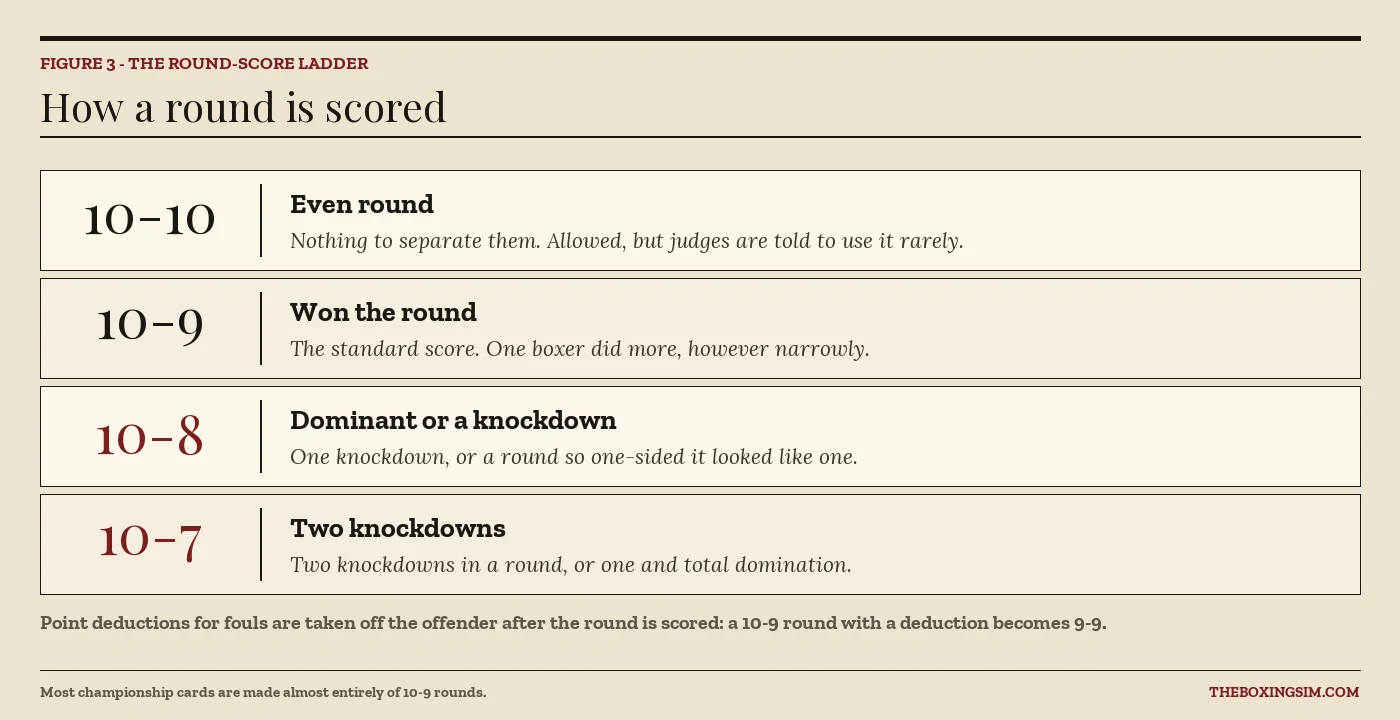
10-9 is the heartbeat of the system. One boxer did more than the other, whether he won the round by a mile or by one clean right hand in the last ten seconds, and he gets 10 while the other gets 9. There is no 10-9.5. A razor-thin round and a clear round are worth exactly the same, which is why close fights so often produce cards that look wildly different from each other: a judge who narrowly gives four close rounds one way ends up four points apart from a judge who narrowly gives them the other way.
10-8 is for a round with a knockdown, or, much more rarely, a round so one-sided that one boxer was on the edge of being stopped without actually going down. Judges are generally encouraged to use the 10-8 for domination more often than they do; in practice most 10-8 rounds you will ever see have a knockdown in them.
10-7 usually means two knockdowns in one round. Anything lower is almost unheard of, because by then the referee has usually stopped the fight.
10-10 is an even round. It is allowed, but most commissions tell their judges to find a winner whenever one exists, so many experienced judges go years without writing one.
What happens when both boxers go down
Knockdowns are scored against each other. If Red is dropped early in a round and Blue is dropped late, the knockdowns cancel and the judge scores the round on the rest of the action, normally 10-9 to whoever did better.
Point deductions
Deductions are not the judges’ decision. The referee warns a boxer for low blows, holding, headbutts or hitting on the break, and when the warnings run out he tells the judges to take a point. The judge scores the round first and then applies the deduction, so a boxer who won a round 10-9 but was docked a point finishes it 9-9. A boxer who lost a round and was docked finishes it 10-8 down. A deduction can therefore turn a lost fight into a draw, or a draw into a loss, which is why referees are reluctant to take points and why it matters so much when they do.
What judges are actually looking for
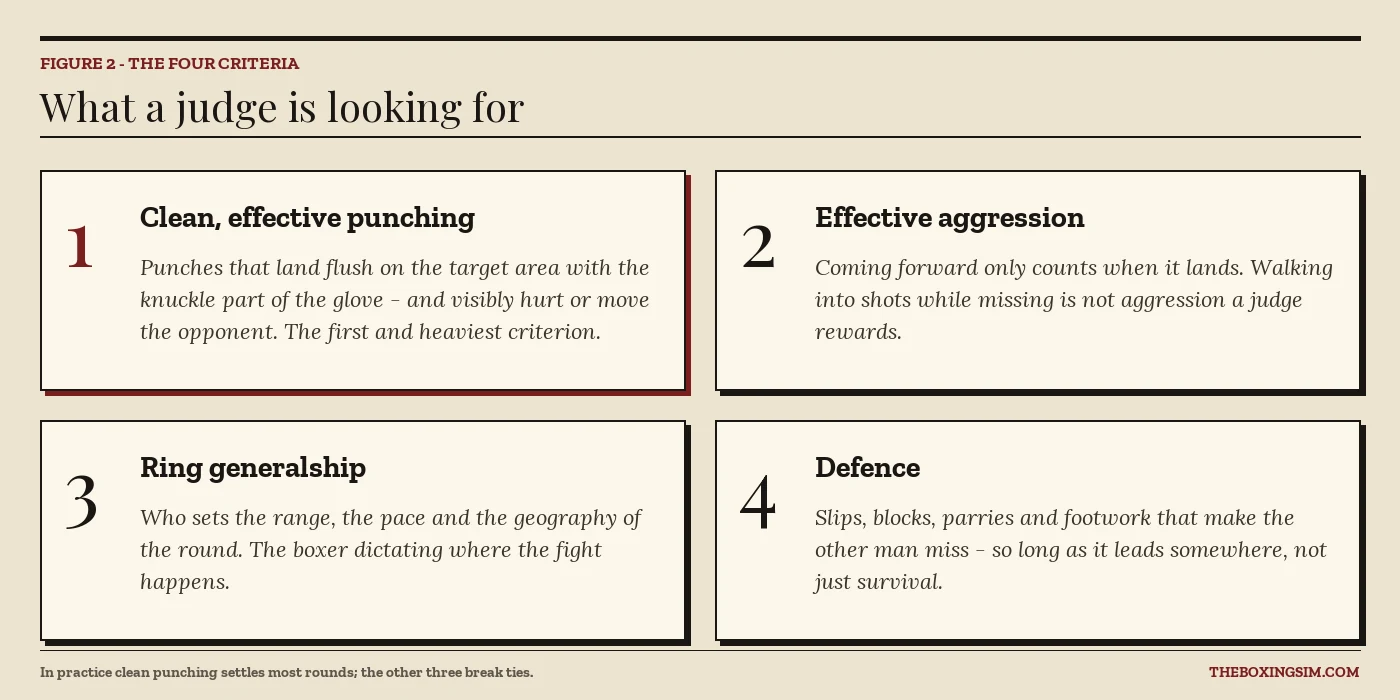
Every set of rules lists the same four things, in roughly this order of weight.
- Clean, effective punching. Punches that land with the knuckle part of the glove on the front or side of the head or body, above the belt. “Effective” matters: a punch that snaps a head back or makes a man hold counts for more than a slap that lands without effect. Punches on the gloves and arms do not count, however loud they sound on television.
- Effective aggression. The key word is effective. Walking forward while eating jabs is not aggression a judge should reward; walking forward and landing is. Many of the worst decisions in boxing come from judges who confuse the two.
- Ring generalship. Control of the fight: who is setting the range, the pace and the location. A boxer who keeps the other one on the ropes, or who keeps him at the end of a jab when he wants to be inside, is winning the generalship.
- Defence. Making the other man miss, with the head, the gloves or the feet. Defence on its own does not win rounds; defence that sets up counters, or that makes a pressure fighter look lost, does.
In practice the first criterion decides the large majority of rounds. The other three become important only when the punching was close to even, which in a fight between two good boxers can be a lot of rounds.
Reading a full scorecard
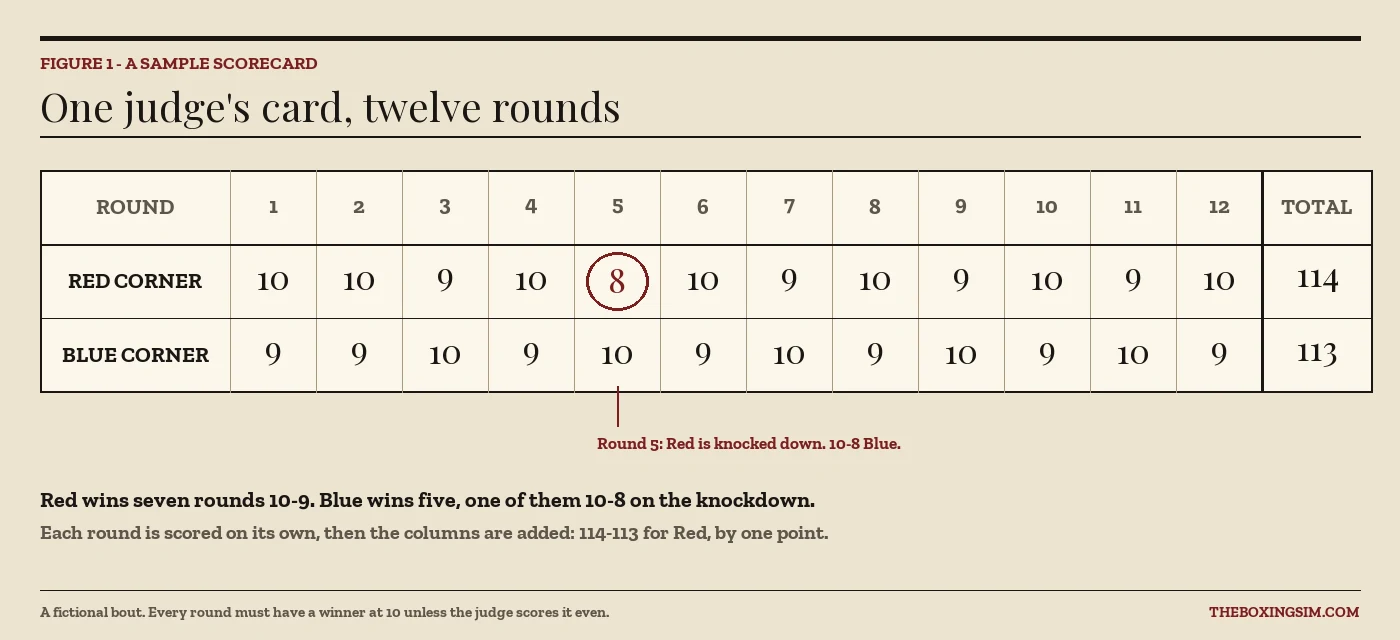
A twelve-round card has twelve boxes per boxer. Add each column and you have that judge’s verdict. The example above shows a very common shape: Red wins seven rounds 10-9 and Blue wins five, one of them 10-8 because Red was knocked down in the fifth. Red scores 70 + 36 + 8 = 114, Blue scores 63 + 50 = 113. The knockdown almost levelled the fight on its own; one more round for Blue and the card would have read 113-114 the other way.
That arithmetic is worth holding on to when you watch a fight. A knockdown is worth one extra point, the same as the swing of a single close round. A boxer who is dropped early has not lost the fight, and a boxer who scores a knockdown has not won it.
Why the three cards so often disagree
Two judges watching the same fight can end up four or six points apart without either being incompetent. They sit on different sides of the ring and see different punches. They weigh the criteria slightly differently. And because every close round is worth a full point either way, small differences in how the close rounds went pile up. Wide disagreements, on the other hand, usually point to a judge who rewarded the wrong thing: aggression without accuracy, or the crowd’s noise.
From three cards to a verdict
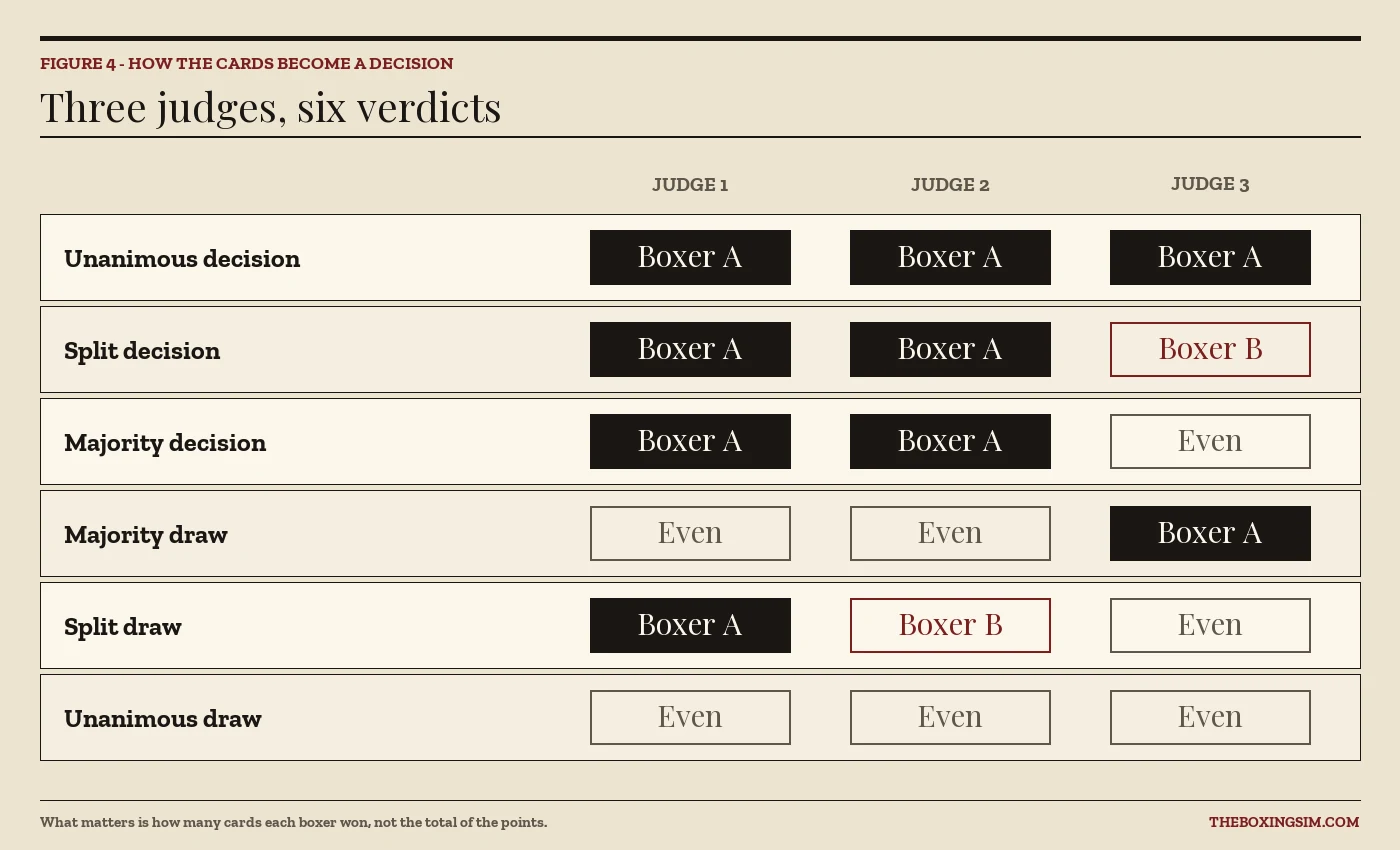
When a fight goes the distance the three totals are read out and the result is decided by how many cards each boxer won:
- Unanimous decision (UD)
- All three judges score for the same boxer.
- Split decision (SD)
- Two judges for one boxer, one for the other.
- Majority decision (MD)
- Two judges for one boxer, the third scores it even.
- Draws
- A majority draw has two even cards; a split draw has one card each way and one even; a unanimous draw has three even cards. In a title fight, a draw means the champion keeps the belt.
- Technical decision (TD)
- An accidental foul, most often a clash of heads, stops the fight after the point set by the rules (usually the end of the fourth round). The judges add up the rounds already fought, including a part-round where the local rules allow it. Before that point the result is a no contest or a technical draw.
Notice that the total of the three cards does not matter. A boxer can lose a split decision while being ahead on the combined points, because he won one card by a mile and lost two by a point each.
Two famous cards that show how the system bends
Lennox Lewis vs. Evander Holyfield, 1999. At Madison Square Garden most of the watching world thought Lewis had won clearly. One judge had him ahead 116-113, but another scored it 115-113 for Holyfield and the third had it even at 115-115, and the undisputed heavyweight title fight was declared a split draw. The outcry led to investigations and an immediate rematch, which Lewis won on the cards.
Canelo Álvarez vs. Gennadiy Golovkin, 2017. Another split draw, and another card that became the story: one judge scored it 118-110 for Álvarez, ten rounds to two, in a fight most observers had close or in Golovkin’s favour. The other two cards read 115-113 for Golovkin and 114-114. A wide card in a close fight is exactly the kind of outlier the three-judge system is supposed to absorb, and here it decided the verdict.
Both fights show the same weakness. Three judges and whole-point rounds make the system resistant to one small error, but not to one large one.
What the scorecard does not count
- Punch statistics. CompuBox and similar counts are unofficial, made by people off to the side, and judges never see them. They are a useful guide, not evidence.
- Who looks worse afterwards. Swelling and cuts are the result of punches, and it is the punches that are scored. A boxer who marks up easily is not losing rounds because of his face.
- The crowd. Noise follows the home fighter and the big swings, not the clean punches. Good judges learn to ignore it; hometown decisions happen when they do not.
- The previous round. Each round starts at zero. A judge should not give a round to a boxer because he “deserved one back” or because the last one was close.
How The Boxing Sim scores its fights
When you simulate a fight on this site, the engine does something close to what a real panel does. Every round has a true winner, set by the two boxers’ ratings, styles and condition on the night. Rounds are also marked clear or close. On a clear round all three simulated judges agree. On a close round each judge has roughly a one-in-three chance of seeing it the other way, independently of the other two, which is how split and majority decisions happen in the simulator without anyone being bent. Knockdowns score 10-8 and no judge can flip them. A round in which the fight is stopped is not scored, while a corner retirement between rounds leaves the finished round on the cards, just as in the real sport. And the hometown setting gives a small lift on the close rounds, never on the clear ones.
That is why you can run the same fight twice and get a unanimous decision one time and a split the next: the fight was the same, the close rounds were not. Try a genuinely even pairing over twelve rounds and watch the three cards drift apart.
SCORE A FIGHT IN THE SIMULATOR →
If you want to see scoring from the other side, the Boxing Career game puts your own boxer in front of the judges, and Boxing Manager lets you decide whether a close decision is worth a rematch. The weight classes guide explains the other thing every boxing result depends on: who is allowed in the ring with whom.
Frequently asked questions
- What is the 10-point must system in boxing?
- Each judge must give the winner of every round 10 points and the loser 9 or fewer. After the last round the judge adds up the points; the boxer with the higher total wins that card.
- How many points is a knockdown worth?
- A knockdown normally turns a 10-9 round into 10-8 for the boxer who scored it. Two knockdowns in the same round usually make it 10-7. If both boxers go down in the same round, the knockdowns cancel out.
- What is the difference between a split decision and a majority decision?
- In a split decision two judges score for one boxer and the third scores for the other. In a majority decision two judges score for one boxer and the third scores the fight a draw.
- Can a boxing round be scored 10-10?
- Yes. A judge can score a round even when nothing separates the boxers, but most commissions ask judges to pick a winner whenever they can, so 10-10 rounds are rare in professional boxing.
- Do punch stats decide who wins a boxing match?
- No. Punch-count services such as CompuBox are unofficial and the judges never see them. Judges score what they see from their seat, round by round, and one hard clean punch can outweigh several light ones.
- What happens if a fight is stopped by an accidental head clash?
- If an accidental foul stops the fight early (before the fourth round under most rules) it is ruled a no contest or a technical draw. After that point the judges add up the completed rounds and the result is a technical decision.