Boxing, explained
How Many Rounds Are in a Boxing Match?
Three in the Olympics, four on a debut, twelve for a world title: how long a boxing match lasts at every level, why the old fifteen-round title fight disappeared, and how often a fight actually goes the distance.
The short answer is twelve for a men’s world title fight, and anywhere from four to ten for everything below it. The longer answer depends on who is fighting, at what level, and in which era. A boxing match is not a fixed length like a football game: the number of rounds is written into each fight’s contract, approved by the local commission, and announced on the poster. Here is how it works at every level, why the numbers are what they are, and, from our simulator, how often a fight of each length actually makes it to the final bell.
The quick answer
- Olympic and amateur boxing: 3 rounds of 3 minutes.
- A professional debut: usually 4 rounds, sometimes 6.
- Prospects and undercard fights: 6 or 8 rounds.
- Regional titles and main events: 8, 10 or 12 rounds.
- Men’s world title fights: 12 rounds of 3 minutes.
- Women’s world title fights: usually 10 rounds of 2 minutes.
- Between every round: 1 minute of rest in the corner.
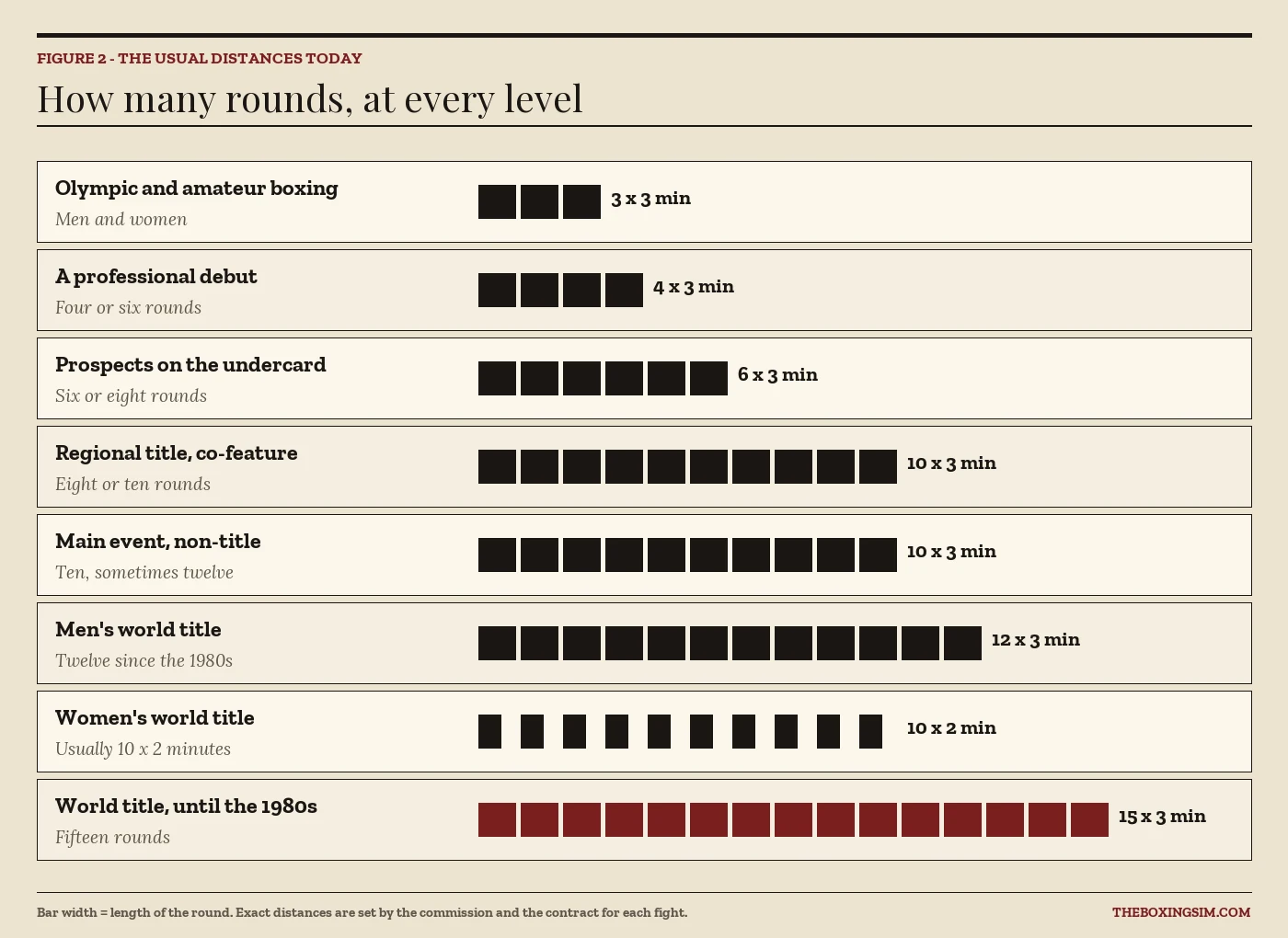
How long a round lasts, and why
A round in men’s boxing is three minutes long, followed by one minute of rest. That rhythm comes from the Marquess of Queensberry Rules, drafted in 1867, which also brought in padded gloves and the ten-count. Before them, under the London Prize Ring Rules, a round lasted until one man went down, and the fight went on until one of them could not come up to the scratch line. Bare-knuckle fights could run for dozens of rounds and several hours.
The longest gloved fight on record shows how far that tradition stretched into the Queensberry era: Andy Bowen and Jack Burke boxed 110 rounds in New Orleans in 1893, more than seven hours, until the referee called it a no contest because neither man could carry on.
The three-minute round with a one-minute rest has hardly changed since. It is long enough for a boxer to build an attack and short enough that the rest matters: sixty seconds is when the cutman works, the trainer gives instructions, and a hurt fighter tries to clear his head.
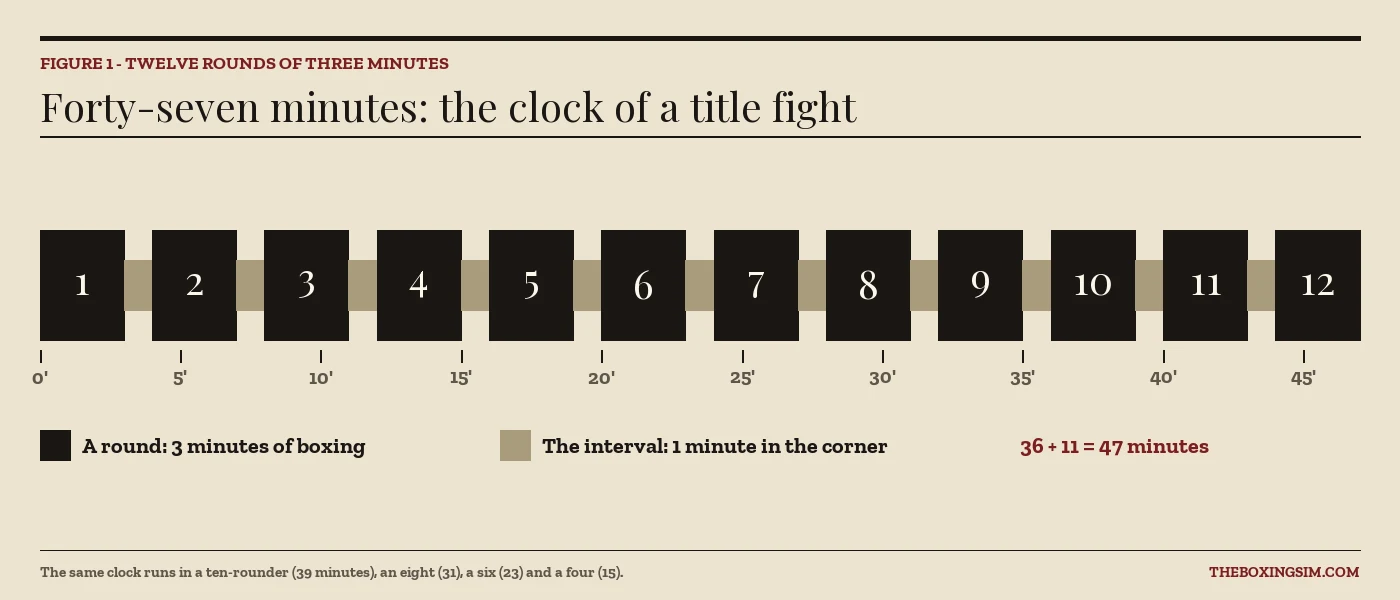
So a twelve-round fight that goes the distance lasts 47 minutes of fight time. A ten-rounder lasts 39 minutes, an eight 31, a six 23 and a four 15. Add the walk-outs, the anthems, the instructions and the reading of the cards, and a main event takes an hour or more from ring walk to result.
Professional fights: from four rounds to twelve
In professional boxing, the distance grows with the boxer’s career.
Four and six rounds are for debuts and the first year or two of a career. A new professional, even a decorated amateur used to three-round fights, needs to learn to pace himself, and his opponents at this stage are usually chosen to give him rounds rather than trouble.
Six and eight rounds are where prospects are tested on the undercard. An eight-rounder asks a real question of a boxer’s conditioning: the punches that would have finished a four-round fight have to be repeated, and the opponent gets time to adjust.
Ten rounds is the standard for regional titles, television main events and many non-title fights between contenders. Some regional and continental titles are fought over twelve.
Twelve rounds is the distance for every world title fight sanctioned by the WBC, WBA, IBF and WBO, and for most final eliminators. The last few rounds of a title fight are still called the championship rounds, a phrase that once meant rounds thirteen to fifteen.
Why title fights stopped at fifteen
For most of the twentieth century, world title fights were scheduled for fifteen rounds. Many of the most famous fights in the sport’s history were fifteen-rounders, and some of their most dramatic moments came in the thirteenth, fourteenth and fifteenth.
That changed after November 1982, when the South Korean lightweight Duk Koo Kim was stopped in the fourteenth round of a WBA title fight against Ray Mancini in Las Vegas and died of brain injuries days later. The WBC cut its title fights to twelve rounds shortly afterwards, and the WBA and IBF followed later in the 1980s. Since then twelve has been the championship distance, and the medical case for the change, that the risk to a tired, hurt boxer rises sharply in the late rounds, is now widely accepted.
Women’s boxing: ten rounds of two minutes
Most women’s professional fights, including most world title fights, are scheduled for ten rounds of two minutes, with the usual one-minute rest. That is 20 minutes of boxing against 36 in a men’s title fight, and it is one of the most argued-about rules in the sport.
The case for change has grown with the women’s game. In October 2023 Amanda Serrano defended her featherweight titles against Danila Ramos over twelve three-minute rounds, the same distance as a men’s title fight, and gave up her WBC belt rather than accept the shorter format. Most women’s title fights are still ten twos, but the question is now open in a way it was not a few years ago.
Shorter rounds change how women’s fights unfold. With less time per round to break an opponent down, women’s boxing has a much lower knockout rate than men’s, and in our roster the women’s divisions sit well below the men’s for stoppages.
Amateur and Olympic boxing
Olympic boxing is three rounds of three minutes for both men and women. Amateur bouts below elite level are often shorter, with two-minute rounds for youth boxers. The short distance is why the amateur and professional games feel so different: a three-round fight rewards fast starts, high work rate and clean scoring, while a twelve-rounder rewards pace, patience and the ability to take something away from an opponent over time.
How often does a fight go the distance?
This is where we can add something you will not find in a rulebook. The simulator on our homepage lets you pick the distance of any fight, and its knockout model is built on each boxer’s real knockout record. We ran about 37,000 fights at each distance, pairing current contenders at random within their own men’s division, and counted how many reached the scorecards.
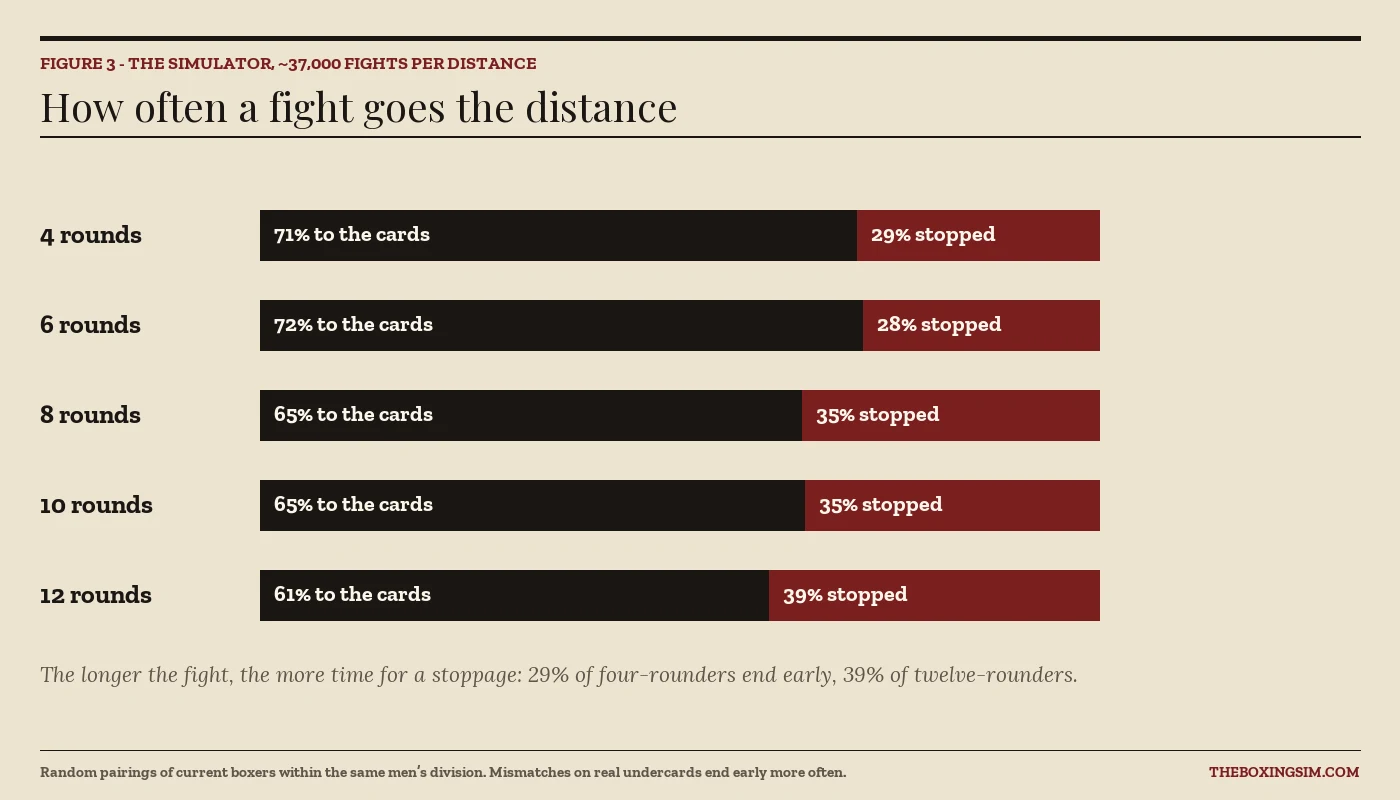
Between boxers of a similar level, about 71% of four-rounders go to the cards, and the share falls as the distance grows, to about 61% of twelve-rounders. Every extra round is another three minutes for damage to add up and another chance for a power puncher to land. Real undercards stop more often than this, because early-career fights are often deliberate mismatches; this is what happens when the two boxers are actually competitive.
Of the twelve-round fights in the simulation, about 39% ended in a unanimous decision, 12% in a split decision and 7% in a majority decision; knockouts and referee stoppages each accounted for about 17%, with cuts and corner retirements making up most of the rest and draws under 3%.
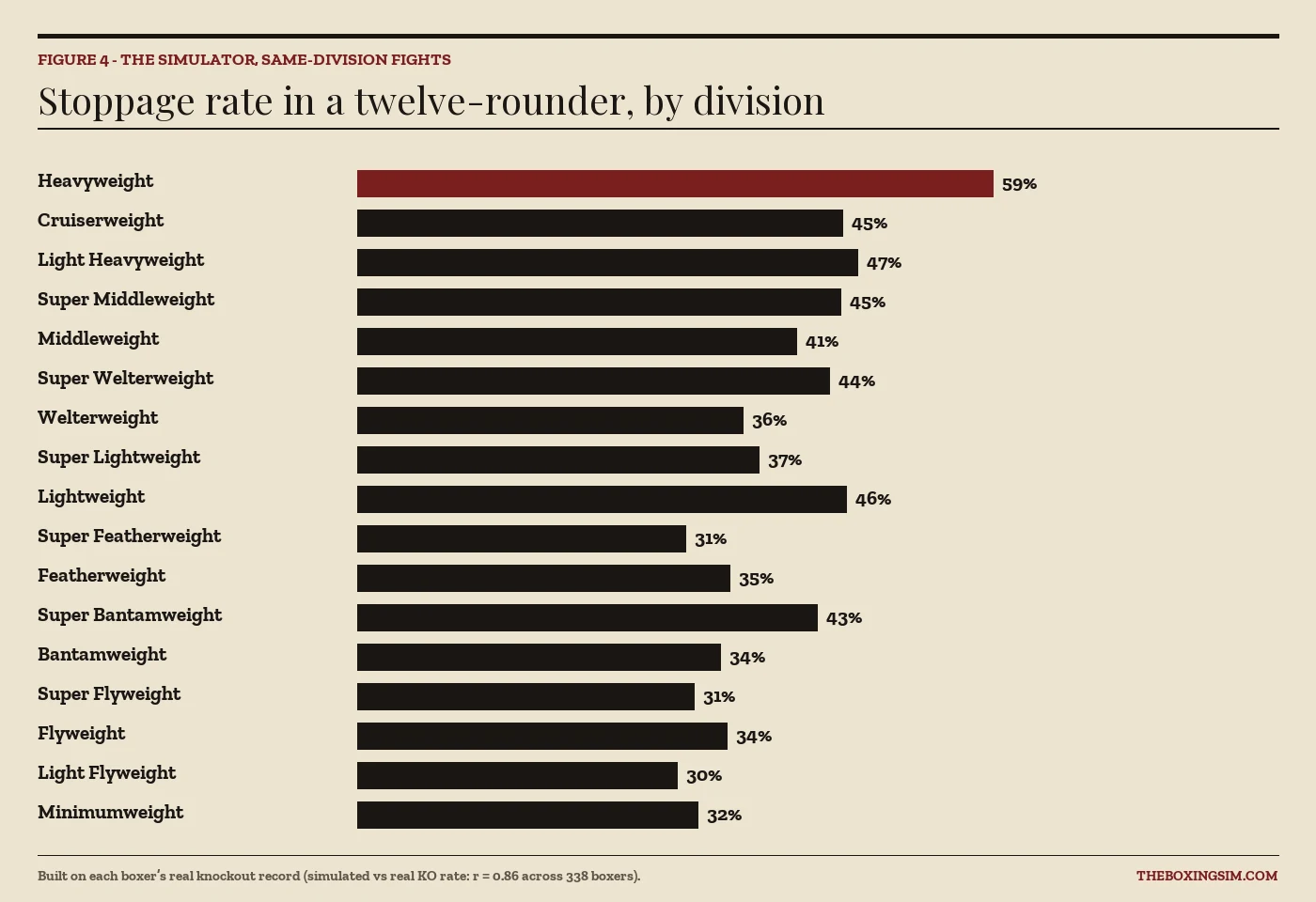
Weight makes the biggest difference. In the simulator, 59% of heavyweight twelve-rounders end inside the distance, against roughly 30% in the lightest men’s divisions. Bigger men hit harder relative to what their opponents can absorb, and the gap shows in their real knockout records, which the engine is built on. If you are watching a heavyweight title fight, the odds are that it will not see the twelfth round. If you are watching the flyweights, settle in.
What happens if a fight is stopped between scheduled rounds?
The scheduled distance only matters if nobody is stopped. A fight can end before the final bell by knockout, by the referee stopping it, by the ringside doctor ruling a boxer unable to continue, or by a corner retiring its fighter between rounds. If a fight is stopped because of an accidental foul, such as a clash of heads, the result depends on how far it got: before the end of the fourth round it is usually a no contest or a technical draw, after that the judges’ cards up to that point decide it as a technical decision. We go through the scorecards in detail in how boxing is scored.
Try every distance yourself
The quickest way to feel the difference between a six-rounder and a twelve-rounder is to run the same fight at both. Pick a big puncher and a slick boxer in the fight simulator, set it to six rounds, then to twelve, and watch how the puncher’s chances change as the fight gets longer. In Boxing Career your own boxer climbs the same ladder, from four-round debuts to the twelve-round title shot.
SET THE DISTANCE AND SIMULATE →
Frequently asked questions
- How many rounds are in a professional boxing match?
- Between four and twelve. Debuts and early fights are usually four or six rounds, prospects box six or eight, regional title fights and main events eight to twelve, and men’s world title fights are twelve rounds. The exact number is agreed in the contract and approved by the commission.
- How long is a round in boxing?
- Three minutes in men’s professional and Olympic boxing, with one minute of rest between rounds. Most women’s professional fights use two-minute rounds, also with a one-minute rest.
- How long does a 12-round boxing match last?
- Twelve rounds of three minutes plus eleven one-minute intervals: 47 minutes if it goes the full distance, not counting the introductions, the referee’s instructions or the reading of the scorecards.
- Why are title fights 12 rounds and not 15?
- The WBC cut its title fights from fifteen rounds to twelve in the early 1980s, after the death of Duk Koo Kim, who was stopped in the fourteenth round against Ray Mancini in November 1982. The other major sanctioning bodies followed later in the decade.
- How many rounds are in Olympic boxing?
- Three rounds of three minutes, for both men and women, with one minute of rest between rounds.
- How often does a 12-round fight go the distance?
- It depends heavily on the division and the matchup. In our simulator, which is calibrated on real knockout records, about 61% of twelve-round fights between same-division contenders go to the scorecards, falling to about 41% at heavyweight.