By the numbers
The Southpaw Advantage, Measured: 406 Boxers and 56 Real Fights
One person in ten is left-handed. Four in ten of the champions on our roster fight southpaw. We counted, and then we asked real fights how much the stance is worth.
Ask any trainer about southpaws and you will hear the same complaint: left-handed boxers are awkward. Their jab comes from the wrong side, their power hand lines up with your open side, and their lead foot is always in the way of yours. The question is whether that awkwardness is worth anything on the scorecards, or whether it is just something trainers grumble about. We had the data to find out.
What we measured
The Boxing Sim roster holds 406 boxers: current champions and contenders in all seventeen men’s divisions and the main women’s divisions, plus 99 legends from earlier eras. Every one has a recorded stance: orthodox, southpaw, or switch-hitter for the handful who genuinely fight both ways (Tyson Fury, Terence Crawford, Marvin Hagler, Jaron Ennis and Yoali Mosqueda). We kept the switch-hitters apart throughout, so “southpaw” below always means a boxer who fights left-handed by default.
We used that roster for two things: who gets to the top, and what southpaws look like in the ratings. Then we took the 179 real results our engine is tested against (we wrote about that test in our backtest article) and pulled out every fight between a southpaw and an orthodox boxer. There were 56.
Left hands are rare. Left-handed champions are not.
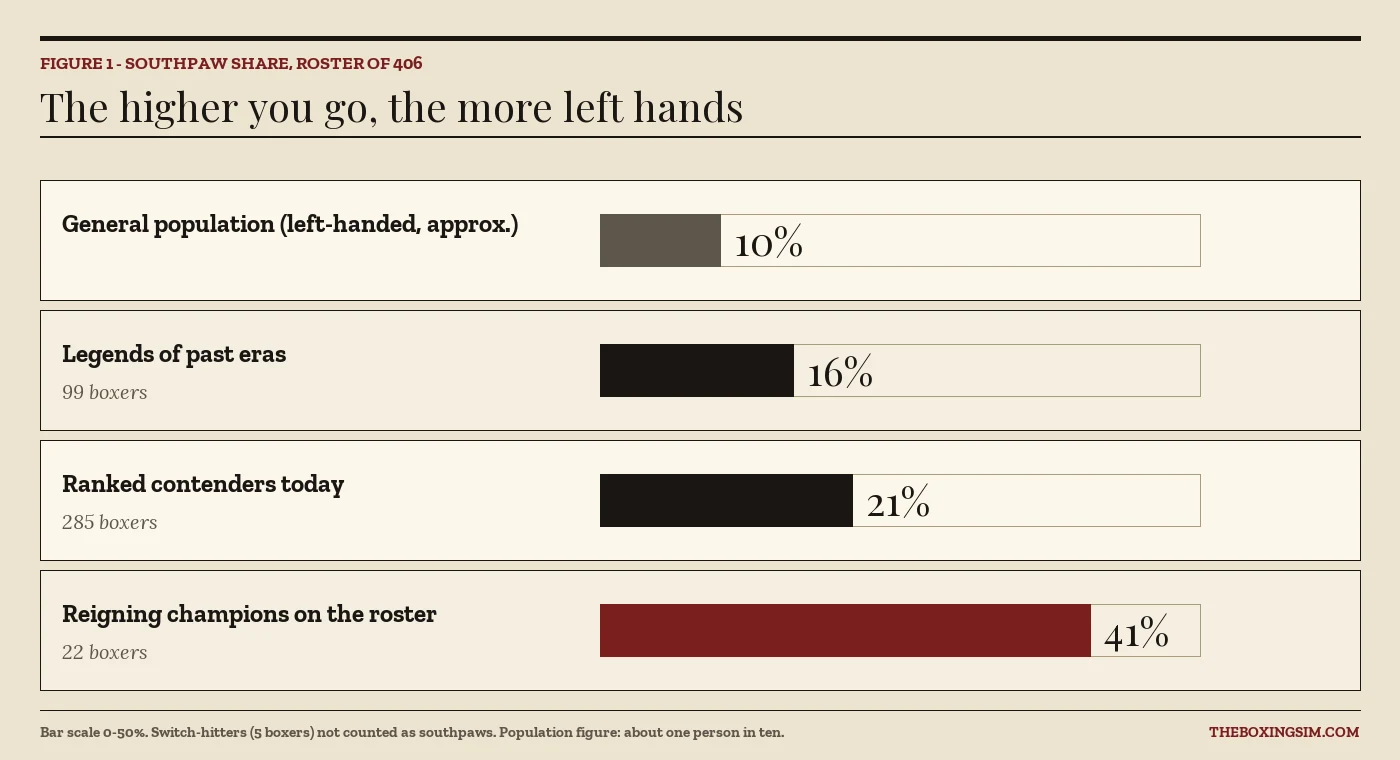
About one person in ten is left-handed. Among the 285 ranked contenders on our roster the share of southpaws is 21%, roughly double. Among the 22 boxers the roster lists as reigning champions it is 41%: Oleksandr Usyk, Jai Opetaia, Osleys Iglesias, Shakur Stevenson, Jesse Rodríguez, Oscar Collazo, Lauren Price, Caroline Dubois and Amanda Serrano, with the switch-hitting Jaron Ennis on top of that.
Twenty-two is a small number, and nobody should build a theory on nine names. But the direction is the same at every level of the pyramid, and it matches what researchers have found in other one-on-one sports such as fencing, tennis and martial arts: the more selective the level, the more left-handers you find there.
The legends are interesting in their own right. Only 16% of our historical boxers are southpaws, fewer than today’s contenders. Part of that is history: for much of the twentieth century, left-handed boys were often turned around in the gym and taught to box orthodox. Some of the great orthodox fighters of the past were natural left-handers who were never allowed to stand the way they wanted.
What a southpaw looks like
If southpaws win more, is that because of the stance, or because the ones who reach elite level are simply better boxers? The ratings give a first answer. On average, against the 316 orthodox boxers on the roster, the 85 southpaws are rated:
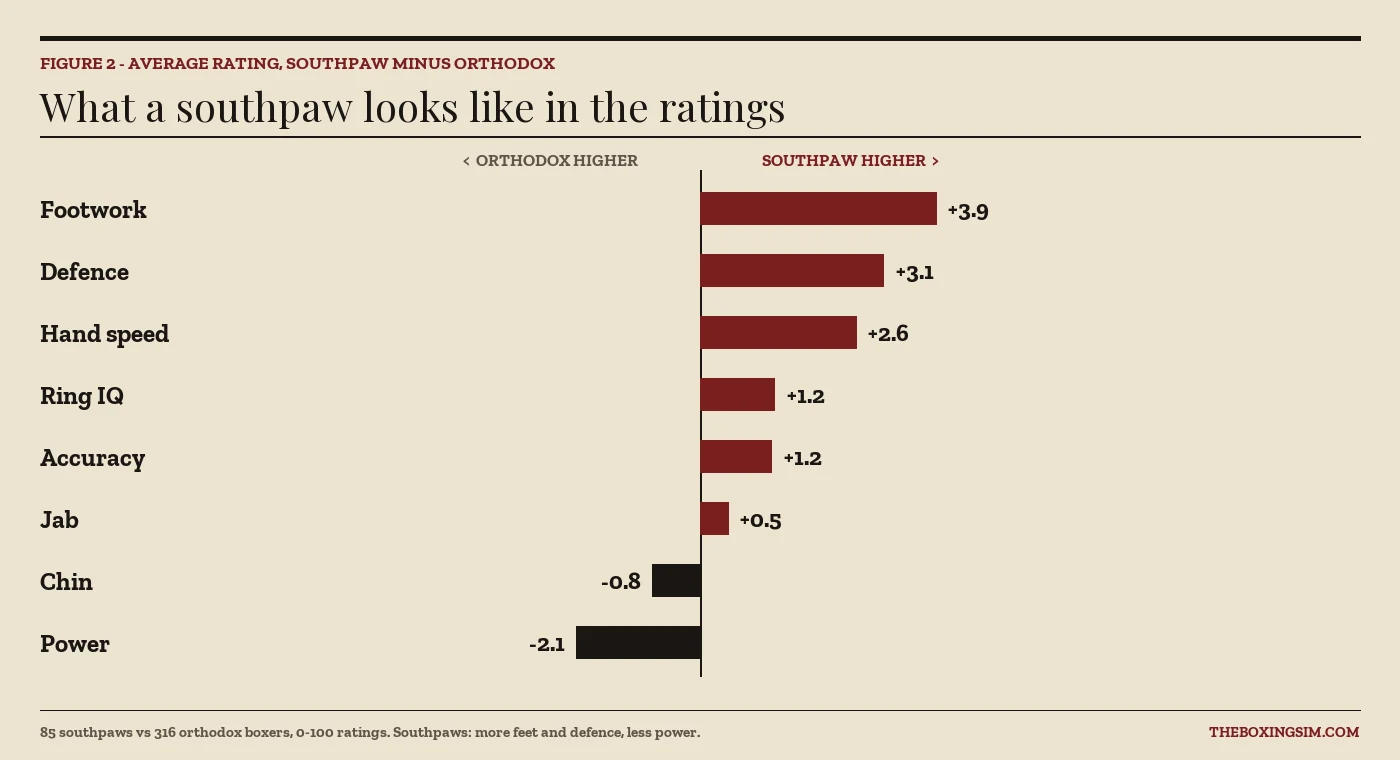
The pattern is clear even if the gaps are modest. Southpaws on the roster are about four points better on footwork, three on defence and two and a half on hand speed, and about two points lighter on power. Their knockout rate is lower too: 61% of their wins come inside the distance, against 64% for orthodox boxers.
This makes sense from the inside of a fight. Against an orthodox opponent, a southpaw’s whole game is a battle over the position of the lead foot. Whoever gets his front foot outside the other man’s has a clear line for the power hand and the other man does not. Southpaws who succeed tend to be the ones who win that battle with their feet and make the other man miss: Pernell Whitaker, Vasiliy Lomachenko, Guillermo Rigondeaux and Shakur Stevenson are all built that way. The left hand gives you the angle; the feet let you use it.
So how big is the edge?
Here is where the real fights come in. In the 56 fights between a southpaw and an orthodox boxer in our test set, the southpaw won 34, a rate of 61%.
That alone proves nothing, because the southpaws in those fights were often the better boxers. Manny Pacquiao alone accounts for thirteen of them. So we asked a more useful question: given the two boxers’ ratings and everything else the engine knows about reach and style, but with stance switched off, how many fights would the southpaws have been expected to win? The answer is 31.0. They won three more than that.
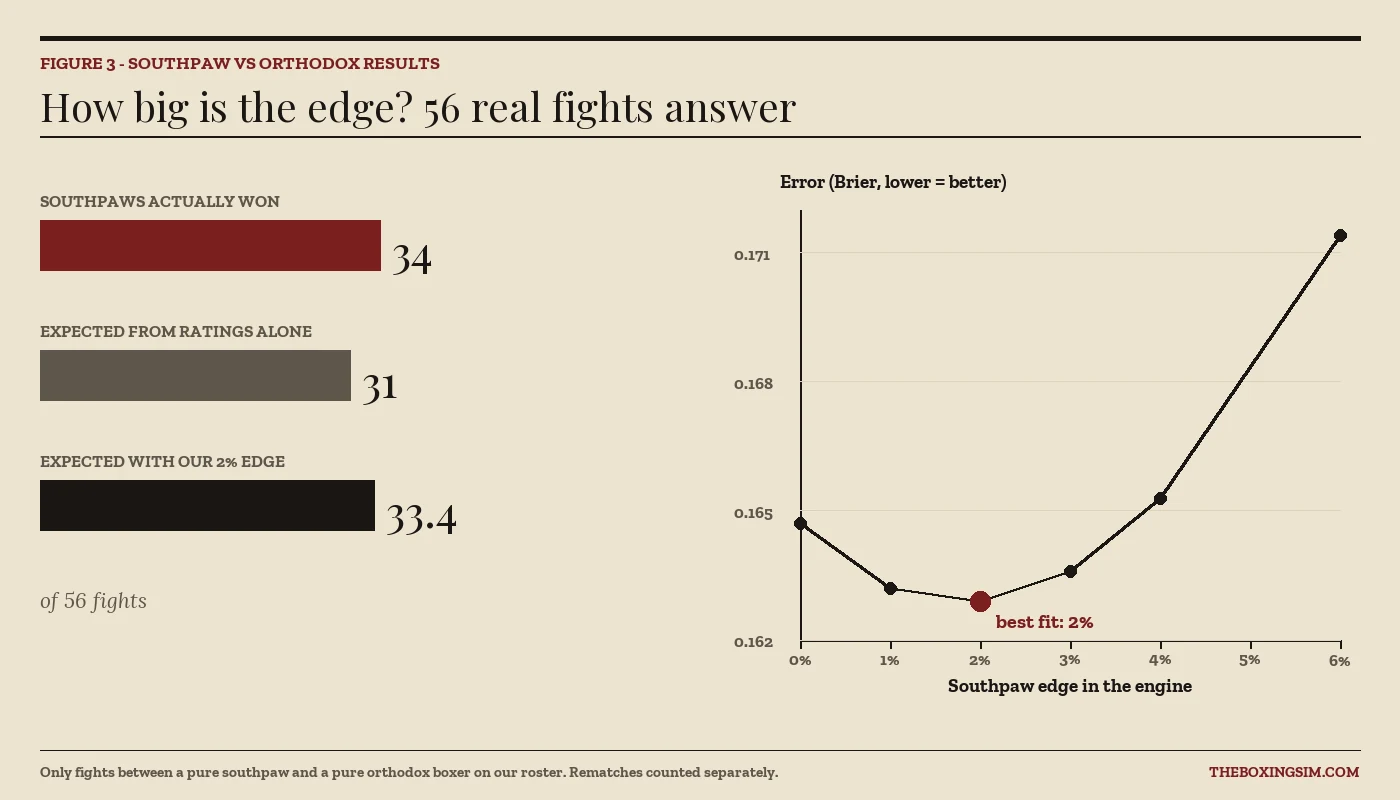
Then we tried different sizes of edge, from none to six percent of a boxer’s fighting strength, and measured how well the engine predicted the 56 results with each. The error falls as the edge rises to 2%, then climbs again. At 2% the engine expects the southpaws to win 33.4 fights, close to the 34 they actually won. At 6% it expects 37.8, and the predictions get clearly worse.
Two percent does not sound like much. In practice, between two evenly matched boxers it moves the odds from 50-50 to about 56-44 in the southpaw’s favour. That is the size of edge a promoter’s matchmaker or a betting market would care about, and a fight between close equals is exactly where it shows up. Between a champion and a contender, stance barely registers; talent decides.
It is also the edge the simulator already uses. We want to be clear that 56 fights is too few to rule out an edge of 1% or 3%. What the data does rule out is a large one. Southpaws are awkward, not unbeatable.
Why the edge exists
The most convincing explanation is simple familiarity. A right-handed boxer spends most of his training life sparring other right-handers, so a southpaw is a puzzle he solves only a few times a year. A southpaw spends almost every round of his life against orthodox boxers. He has solved that puzzle thousands of times. In other words, the advantage is not in the left hand; it is in the rarity of the left hand.
That also explains why the edge is modest and why it may not grow. As southpaws become more common at the top, orthodox boxers see more of them, camps hire left-handed sparring partners as a matter of routine, and the surprise wears off. It also explains the dreaded southpaw-versus-southpaw fight, which is often an ugly, stop-start affair: two men who have hardly ever had to deal with their own mirror image.
Southpaws by division
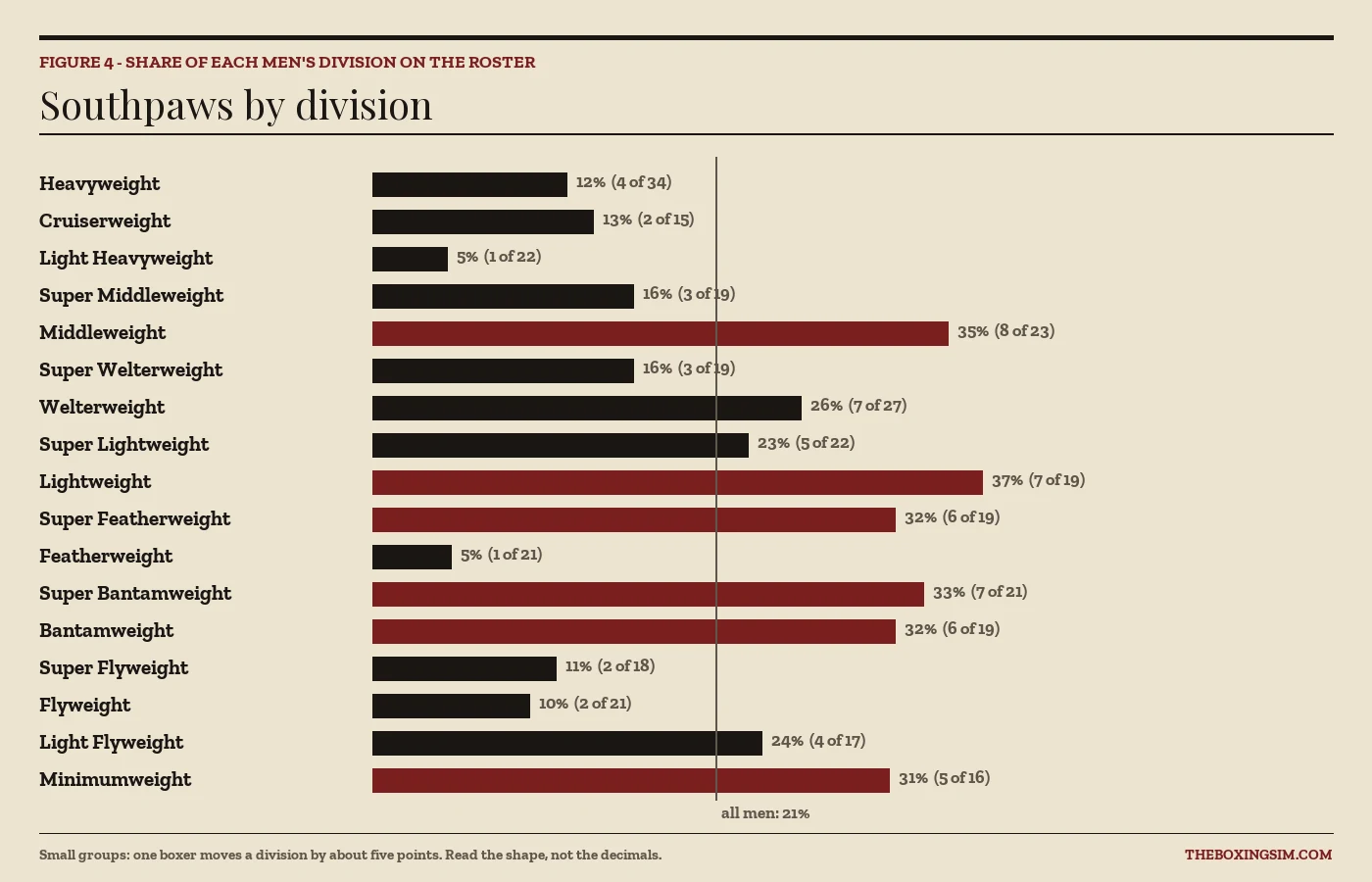
Divided up by weight, the numbers get noisy and should be read with care. Still, the lighter half of the sport, from middleweight down to the small divisions, has noticeably more southpaws than the big men. Lightweight (37%) and middleweight (35%) lead the roster; light heavyweight and featherweight, with one southpaw each, are the most orthodox. Heavyweight sits at 12%, though two of the most important heavyweights of the decade, Usyk and the switch-hitting Fury, complicate any neat story.
What it means for the simulator
In the fight simulator, a pure southpaw facing a pure orthodox boxer gets 2% added to his fighting strength. A switch-hitter gets the same 2% against anyone who cannot switch, since he can choose the uncomfortable stance for the other man. Two southpaws, two orthodox boxers, or two switch-hitters get nothing. Stance does not change how hard anyone hits or how well anyone defends; it only tilts the odds in a close fight.
If you want to see it for yourself, find two close equals of opposite stances and run the fight a few dozen times, then try the same boxer against an orthodox opponent of the same rating. In Boxing Career the same idea shows up in the fight camp: against a southpaw, bringing in left-handed sparring partners takes most of the problem away, which is exactly what real camps do.
PUT A SOUTHPAW IN THE SIMULATOR →
For how the engine was tested against those 179 real fights in the first place, read We Tested Our Boxing Simulator Against 179 Real Fights.
Frequently asked questions
- What is a southpaw in boxing?
- A southpaw stands with the right foot and right hand forward and throws the power punch with the left hand. Most southpaws are left-handed. The opposite stance, left foot forward, is called orthodox.
- Do southpaws have an advantage in boxing?
- A small one. In 56 real fights between southpaws and orthodox boxers on our roster, southpaws won 34, about three more than their ratings alone predicted. The best-fitting size for the edge in our simulator is about 2% of fighting strength.
- Why are there so many southpaw boxing champions?
- Orthodox boxers spend most of their time sparring other orthodox boxers, so a left-hander is an unfamiliar problem, while southpaws face orthodox boxers all the time. That rarity is the most widely accepted explanation for why left-handers are over-represented in combat sports.
- What percentage of boxers are southpaws?
- On our roster of 406 notable boxers, 21% are southpaws and about 1% are switch-hitters. Among the reigning champions on the roster the share is 41% (9 of 22). Roughly 10% of the general population is left-handed.
- How does The Boxing Sim handle southpaws?
- A pure southpaw facing a pure orthodox boxer gets a 2% boost to fighting strength in the simulator. A switch-hitter gets the same 2% against anyone who cannot switch. Two southpaws, or two orthodox boxers, get nothing.